Saturday, April 22, 2006

Remembering John - Adoor Gopalakrishnan

A memoir on late *John Abraham, malayalam movie director by another renowned director, *Adoor Gopalakrishnan in his book Cinema, Literature and Life.

It's been a long while since our beloved John Abraham left all of us. Any attempts to confine his exceptional genius, who left us in unusual circumstance in adjectives or clichés are bound to fail. John never had friends or foes in the extremes. If anyone claims otherwise, it would have to be treated with suspicion. If someone describes him as a prophet who belonged to an extraordinarily lofty plane, I would tend to agree.

Though older, he was three years junior to me at Pune Film Institute which he joined after resigning his job in L.I.C at Kumbhakonam, Tamil Nadu. Typically, first year students would be ignored as novices by their seniors in any educational institution. However, probably for his captivating personality, John attracted our attention and affection. There would always be a bunch of mates around the articulate John. Drama, Painting, Music, literature - be it anything, he had an uncommon grasp and enthusiasm. Sporting a playful smile he was a natural hitting punch line in any debate.

This was a period when all the students at the Institute were struck by the magical spell of Ritwik Ghatak, who was the vice-principal and Professor of Direction. I remember John's arrival at the institute with some fascination for the period. Naturally they got along quite well. I've heard people say Ghatak expected John to have the brightest future of all his students.

If anyone asks for the most important aspect of John's cinema, I would have to mention at the outset, their engrossing black humor. The protagonist riding a motorcycle by pedaling on the starter (Students, this way, 1972), milkman attempting to fool the cow to yield milk by propping up a calf with straws (Donkey in the Brahmin ghetto, 1977), towards the end in the movie, Cruelties of Cheriyachan (1979) the scene is titled "Ascent" with a long shot of the actor perched on top of a coconut tree, and in the same movie you might as well remember Cheriachan's mother narrate her story in monologue in the burial ground right after her death - like soul inside a body all these stood for a universal vision embodied in unique narrative techniques. Artists who cherished the dead and the living, the exciting and the lifeless with the same intensity of indulgence and affection are not to be found anywhere except John. The scene in the Brahmin Ghetto where the lid of a coffin is opened repeatedly revealing the dead body in a mortuary and the still born child in "To Mother" (1986) clearly underline the above.

His unbridled and uninhibited lifestyle and the art that sucked its blood and sweat were merged irretrievably and inevitably by destiny for sure. His life was like a puzzle in a surreal scenario where a theatrical enactment of tragedy rumored, forewarned, accepted and inexorably took place in the end. We realize that with a jolt now. How can we ever say that the scenes from his own life when he lay unrecognized in the Calicut medical college mortuary like a vagabond for days were not adapted by John as he did in "To Mother"? The intellect that distilled the puzzles of life into art and then life itself and even death left a lot of unknowns in the dark.

John was a compulsive traveler, without any belongings, mostly without even another pair of clothing. John can be anywhere-in conscious or unconscious state; inebriate or sober; in groups or alone. We were together when the only time John traveled abroad, to Italy for Pessaro film festival.

The new pair of shoes that *Odessa organizers bought for him did not fit his feet. Nevertheless he was wearing it in the Bombay airport. It was only a few minutes for the flight to depart before we realized John had not done emigration clearance and he was disheartened to be retreating and finally higher authorities intervened to walk alongside to help him fly are not quite the scenes to forget. When everyone took refuge in woolen clothes from the bone chilling cold in Pessaro, John wore cotton clothing on top of another refusing the sweater I offered. After the shows and dinner when everyone else withdrew back into the warmth of their bedrooms, this man was wide awake and walked along the city to conjure the rhythm, sound and material from its nightlife. While our stay in Pessaro was for seven days, John had spent almost fourteen days. Within a few days
We were convinced that John was the most popular, famous and liked participant among us in this Italian city. He did not need to speak Italian to achieve this.

Italy is known for the numerous film festivals conducted every year. Every city conducts one more festivals. As far I know John was invited for at least a dozen of them. The youthful and enthusiastic organizers wanted John to attend them even if his films were not available. The picture of the radiant face of a middle aged bartender who tucked his hand upon his chest and held his breath and deep admiration for John who was stepping on to the stage to answer cineastes’ questions after Brahmin's Ghetto was screened in Pessaro was incredible. I can never forget or erase the magical moment.

We were given a car to visit Rome on the last day of the festival. I had obtained permission to keep the car for the whole day so that I could show the city to John. I took this responsibility upon myself since I had been there three times already. I kept the following vignette in memory. Inside St.Peter's Basilica in Vatican and inhaling the enchanting, resplendent and holy majesty that condensed over centuries, John confessed with pride and a mischievous tinkle in his eyes:

"Standing here if a Christian bloke felt a bit cocky, you can't really blame him".

The journey's triumph and the serene hallow of fulfillment and satisfaction passed on his smile to me.

I understood later that Pessaro was a major reinforcement for John. He afterwards completed "To Mother". He spoke of each step in production with a lot of excitement. How many of them including Rossellini’s son Jill, John promised to come back with the new film? Everyone who cared for him including myself truly believed he had just entered a new phase of artistic endeavor. Unfortunately for Malayalam films, the thing called fate that some believe and others don’t did not let it happen.

Once after a long interval, John visited my home. He asked my daughter:
"Who asked you to grow up?"

I would like to ask him in return:
"Dear John, who asked you to die?"

* * *

* Adoor Gopalakrsihnan: One of the major malayalam movie directors. This is an excerpt from his book Cinema, Literature and Life written in Malayalam. I did the translation of a small segment from the book.

* John Abraham: John was one of the major avant-garde directors in Malayalam cinema. With only four films to his credit he had a major impact on the medium. He had an enigmatic persona who defied all the conventional norms of social codes. Even his death had a stamp of his world vision and seemed to invoke a black humor on society's conducts upon celebrity death. He fell off a multi-storey building and was kept in the mortuary for days before being identified. You can find more about John
here.

* Odessa: Odessa was an avant-garde movement who organized resources for meaningful cinema and spread film societies across the country.

Monday, March 27, 2006

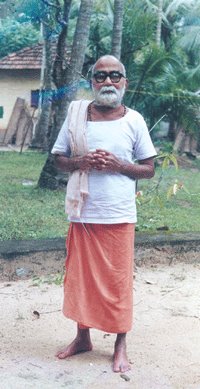
Kunhunni maash

Kunhunni maash was an archetypal teacher of children and adults who have an open and earnest mind of a child to learn. No one has distilled knowledge and enlightenment to the degree of simplicity that he so effortlessly achieved. It spread like sunshine for decades over many generations of young kids who not only soared in their imagination about the open sky he unleashed, but learned the secrets of goodness and being kind and appreciative of mother earth.

For the twenty years I who read his(Kuttettan) editorial notes and advice to budding writers in the Children's Section (Baala-Pankthi) of Mathrubhumi magazine and having met him under a tree along with other students at school, felt the irrevocable loss of his long shadow. It's not just the charm of old world that is lost; I believe it is more than that. I doubt if we can ever find such fine folks anymore who can clear the gloom and guide your spirit to all that is worthy of life and living.

He was a short man. His poems were short. It took the world quite a while to read through the silly word play in his poems to understand the genius. The big and tall truths in small and short words, the nimble sketches of native life in Kerala and the gentle social and political satire have found their way through his poems which bordered on absurdism thematically and a distant similarity on Haiku in style. It is impossible to translate his poems since he used the oral and traditional words and expressions quite liberally. Once taken out of context, they simply wither away. You would feel like you have uprooted a healthy tree. However here is a sample, with due apologies to maash:

"Read or not
You will grow up.
You will reap
If you do,
You will trip
If you don't"


- as an ardent campaigner for library and reading, he has words of wisdom for children and adults.

"I am kunhunni.
My mother? Narayani.
Grand mother? Parukkutti.
Grand mother's mother?
That is the limit of my grasp."


- reveals his humble self even though he is a scholar in Malayalam literature and linguistics besides an accomplished teacher.

"My son must learn English
from the moment he is born.
Hence I had my wife
deliver in England"


- a taunt on the craze of English that began to threaten the existence of Malayalam.

I wish all my readers know how to read Malayalam so that Kunhunni maash could unveil the verdant language and the sprightly spirit of rural Kerala.

He called himself children's poet. There had been numerous child prodigies he nurtured through his writings and otherwise. He traveled for a long time campaigning for the need of libraries and literary activities. The throngs of children visiting his house and playing in the yard must have recognized maash and hopefully one of them would go on to lead his kindly light.

Note: maash is the endearing way of addressing a (school) Teacher.

Thursday, March 16, 2006

A case for Portrait - Revisiting James Joyce Part 2


Stephen grows restless with his decadent life. Father Arnall's hellfire sermon draws his sensibilities on the incursions into the realms of sin and redemption. The contemplations on sin, death, confession and deliverance reveal a quest for a personal god who can restore the beauty and purity of his world. Here he is ruminating on God's majesty and its manifestation in the imagery of Emma, his partner in sin and a vision of biblical deluge:

"-- Take hands, Stephen and Emma. It is a beautiful evening now in heaven. You have erred but you are always my children. It is one heart that loves another heart. Take hands together, my dear children, and you will be happy together and your hearts will love each other.

The chapel was flooded by the dull scarlet light that filtered through the lowered blinds; and through the fissure between the last blind and the sash a shaft of wan light entered like a spear and touched the embossed brasses of the candlesticks upon the altar that gleamed like the battle-worn mail armor of angels.

Rain was falling on the chapel, on the garden, on the college. It would rain for ever, noiselessly. The water would rise inch by inch, covering the grass and shrubs, covering the trees and houses, covering the monuments and the mountain tops. All life would be choked off, noiselessly: birds, men, elephants, pigs, and children: noiselessly floating corpses amid the litter of the wreckage of the world. Forty days and forty nights the rain would fall till the waters covered the face of the earth."

The prose unleashes scores of images as if they were musical notes with spatial awareness of the landscape, chapel's damp light, clouds that gathered above and the rain. I read somewhere that Joyce was a tenor of rare talent.

Noticing the piety and talents in Stephen, the director of the school suggests him to take up priesthood. Caught between the choice and a growing awareness of his true self, Stephen begins to recognise his desire for freedom and the craving for aesthetics of life. He recollects how repulsive the stale odor in the corridors of Clongowes for him and unbearable, the unyielding and obscure questions of catholic doctrines. He accepts the life of imperfection and the smaller joys that are denied in the rigors of religious regimen and canonical penances.

"The faint dour stink of rotted cabbages came towards him from the kitchen gardens on the rising ground above the river. He smiled to think that it was this disorder, the misrule and confusion of his father's house and the stagnation of vegetable life, which was to win the day in his soul."

Stephen passes a turning point a little while before joining the university. He sets off to the seashore and witnesses the mirth of school chums swimming and then the vision of the winged Greek god Dedalus escaping from his prison island. His imagination soared at the spectacular sight of a girl wading in the ocean and his soul cried in an outburst of "profane" joy. For a moment he defied the strangleholds of faith and touched the freedom of spirit. He acquires great faith in the power of creativity and the eternal beauty of seemingly ephemeral objects.

"Her image had passed into his soul for ever and no word had broken the holy silence of his ecstasy. Her eyes had called him and his soul had leaped at the call. To live, to err, to fall, to triumph, to recreate life out of life! A wild angel had appeared to him, the angel of mortal youth and beauty, an envoy from the fair courts of life, to throw open before him in an instant of ecstasy the gates of all the ways of error and glory. On and on and on and on!

He halted suddenly and heard his heart in the silence. How far had he walked? What hour was it?

There was no human figure near him nor any sound borne to him over the air. But the tide was near the turn and already the day was on the wane. He turned landward and ran towards the shore and, running up the sloping beach, reckless of the sharp shingle, found a sandy nook amid a ring of tufted sandknolls and lay down there that the peace and silence of the evening might still the riot of his blood.

He felt above him the vast indifferent dome and the calm processes of the heavenly bodies; and the earth beneath him, the earth that had borne him, had taken him to her breast.

He closed his eyes in the languor of sleep..."

Joyce introduced the imagery of Greek myth to suggest Stephen’s premonitions of Ireland as the Prison Island and exile. This is followed by the revelation of his artistic self and the freedom that came along with it when he felt the exhilaration of watching the girl swim and being engrossed in the beauty and harmony of the moment. He is no longer holding back on the profanity of such joys anymore

We will see a sober and determined Stephen later on. He does not let himself hurt when his father refers to him as "lazy bitch of a brother”. He would not be cowed down by McCann over his petition or swayed by Irish nationalism and politics. He finds college insipid and uninspiring. He explains his theory on the aesthetics that delineates some of the major thoughts in the modern age such as definitions of Kinetic and static arts; lyrical, epic and dramatic forms of art and his views on dramatic art as the most uplifting, rhythm of beauty etc. It is not just Lynch who benefited; it must be the reader who is following Stephen’s intellectual tour-de-force avidly.
The consummation of Stephen's persona and self-expression soon follows when he meets Emma and settles down to write the poem that he couldn't write ten years ago. But he never shows it to anyone. Stephen develops friendship with Cranley and confides everything to him and asks Cranly's advice. Stephen and Cranly have a long conversation about religion, politics, family, and Ireland. Stephen admits, under Cranly's intelligent questioning, that sometimes he fears that the Catholic Church is right and he'll be damned and sent to hell. But he still must choose as he will choose. He realizes with sadness that after he leaves Ireland his friendship with Cranly will come to an end; he accepts that he may be alone. He must be independent. He is not afraid to be alone. He is not afraid of making a mistake, even if that mistake sends him to hell.

We follow Stephen in exile through his diary:

"April 15. Met her today point blank in Grafton Street. The crowd brought us together. We both stopped. She asked me why I never came, said she had heard all sorts of stories about me. This was only to gain time. Asked me was I writing poems? About whom? I asked her. This confused her more and I felt sorry and mean. Turned off that valve at once and opened the spiritual-heroic refrigerating apparatus, invented and patented in all countries by Dante Alighieri. Talked rapidly of myself and my plans. In the midst of it unluckily I made a sudden gesture of a revolutionary nature. I must have looked like a fellow throwing a handful of peas into the air. People began to look at us. She shook hands a moment after and, in going away, said she hoped I would do what I said.

...

April 26. Mother is putting my new secondhand clothes in order. She prays now, she says, that I may learn in my own life and away from home and friends what the heart is and what it feels. Amen. So be it. Welcome, O life, I go to encounter for the millionth time the reality of experience and to forge in the smithy of my soul the uncreated conscience of my race.

April 27. Old father, old artificer, stand me now and ever in good stead.

Dublin, 1904

Trieste, 1914"

You cannot read the book in one go, even though it is relatively skinny. You would have to revisit midway or on a random imagery or a composition that Joyce indulged you in. In all these you would realize the brave and firm convictions of Stephen Dedalus who grew up to become James Joyce. He lived in exile somewhere in Trieste which is no more than a windswept crossroad in Europe.

I chanced upon this book and the charmed world of Stephen. Revisiting after so long is like recreating the life and times with hope and innocence.

A case for Portrait – Revisiting James Joyce Part 1

Reading Portrait while I'd just begun hobnobbing with literature left me with vague stirrings of the inner workings of a mind. A mind flourished in the throes of awakening into the grace of wisdom and anguish.

I remember the sunshine in those evenings and creaky window of my cousin’s attic overlooking the cemetery of the church sharing the fence. I was captivated by some of those dreamy passages in the book and I knew Stephen Dedalus was here to stay. The seductive power of Joycean language weaved a bit of magic tangle for me, even when I wasn't aware or never curious for Irish politics, his specifics of catholic dogmas and the morals of the Irish society in general.

However what was palpable at the time was an instant recognition of Joyce's genius and how tactile was Stephen Dedalus' mind that worked its way through an evolving awareness from his childhood. The autobiographical signposts in the book were as misleading as seemingly direct and simple literary techniques employed. Stephen narrated his own life in various phases and evolution of his consciousness built up on a masterful control of words. What set Joyce apart from most was the unprecedented ability to combine his rebellious experiments in form and content.

Joyce lived in exile and in attempts to ward off impoverishment. In many ways the self imposed exile left him living on the edge. The crossroads in Trieste where he stayed, inhabited by people of multiple nationalities provided him a linguistic melting pot and the psyche of an exile. The Portrait to Ulysses and culminating in Finnegan’s Wake provide ample evidences of this progression.

Portrait of the Artist as a Young Man (1914) is special not in the least it pioneered stream of consciousness form, not even the brilliance of language but the fact the book has a lot of heart in it. You would find the spirit and its mellowing of consciousness in the transitory stages of childhood, adolescence and youth. You would imbibe as much as you revel in the sensitivity applied in his imageries and the narrative.

Stephen's childhood goes through the bittersweet experiences surrounding his parents, governess Dante, Catholicism and Conglowes School. His impressionable mind responded to the seemingly overwhelming and insecure life and times. His fascination for the innocence of Eileen who is a protestant is disapproved, the induction of church, nationalism and politics at the dinner table with him as witness, his sense of punishment and justice when he complains to the rector about Father Dolan as the latter pandied him for the broken glasses which he was falsely accused for having done it deliberately - You could find Stephen grow up fast and developing a sensitive but tenacious mind. This evolution is drawn in a metaphor as given below:

"He (Stephen) turned to the flyleaf of the geography and read what he had written there: himself, his name and where he was.

Stephen Dedalus
Class of Elements
Clongowes Wood College
Sallins
County Kildare
Ireland
Europe
The World

The Universe"

Stephen's run-ins into the charms of romanticism and sexuality are the next phase of his life. He would be on a journey to come into terms with his perceptions which are in conflict with his immediate world. The reveries about the girl in the tram and his urges to talk to her, his amorous melancholic visions of Mercedes from Count of Monte Cristo, the unconventional views of writers (the boys attacked him for defending the heretic poet, Byron), his dispassionate realization of his father's failures, his longings and first sexual encounter with a prostitute reveal the growth of an artist's psyche. Joyce employs the metaphor of walking to imply Stephen’s awakenings and you would see him do at different stages of narrative:

"He had wandered into a maze of narrow and dirty streets. From the foul laneways he heard bursts of hoarse riot and wrangling and the drawling of drunken singers. He walked onward, dismayed, wondering whether he had strayed into the quarter of the Jews. Women and girls dressed in long vivid gowns traversed the street from house to house. They were leisurely and perfumed. A trembling seized him and his eyes grew dim. The yellow gas-flames arose before his troubled vision against the vapory sky, burning as if before an altar. Before the doors and in the lighted halls groups were gathered arrayed as for some rite. He was in another world: he had awakened from a slumber of centuries."

The torments of Stephen walking alongside the vagaries of lust and loss of innocence after the brief spells of romance, and the burgeoning of his artistic self finds expression in Joyce's imageries and word play.

Thursday, January 26, 2006

Chronicling Travels

I have been thinking about travels. The journeys mapped in physical and metaphysical coordinates of my own life as I know them. There is no blinking of the eye, no claim of righteousness and an awareness of the triviality of it all - of ignorance and of wisdom against the abyss of time.

One travels through his age, through relationships and through one's own egocentric paths. His inability to relate and establish channels of communication leads him to a state of pervasive conflict. This holds true when the search for self-identity is constrained and defined by external objects and ideas. The inverse of this defines another state of suffocation by one’s own unnamable and unborn identity too.

Irishman 1Becket's seekers found Raison d'etre in the act of waiting or electing not to wait endlessly for a certain Godot. In Unnamable, Becket described a state long before the search for identity when a fetus goes through suffocation and suffering in the womb:

I of whom I know nothing, I know my eyes are open because of the tears that pour from them unceasingly. I know I am seated, by hands on my knees, because of the pressure against my rump, against the soles of my feet? I don't know. My spine is not supported. I mention these details to make sure I am not lying on my back, my legs raised and bent, my eyes closed. (the UnNameable)

Becket reminds the reader all the while that man is an isolated, decaying, self-deluding, un-self-knowing, death-sentenced, rotting, body and mind.

Becket meant to understate a whole bunch of things.

I turn back to 2Vijayan and the travels he chronicled in his Legends of Kazakh. Ravi, the traveller in his book took a ride in the last bus to Kazakh. He left a whole lot of identity symbols behind to take up the job of a single instructor school in this forgotten hamlet.

Ravi once retold the story of karmic travels to his students:

Once upon a time, before reptiles and long before dinosaurs, two cells went for a walk in an evening. They came upon a sunlit valley.

Wonder what lies beyond this? Younger cell asked the bigger one.
This is an emerald valley. Let me linger in here.
I want to go. Younger sister insisted. She looked at the galactic paths that lay ahead.
Will you forget me? Elder sister asked.
I won't. She said.

You will. Elder sister said.
This is a loveless story of karmic cycles. This has separation and grief, nothing else.

I will conclude this with a montage from the same book.

Ravi is alone in the evening at his barn house. He would look through the window...there are no cows grazing outside. Night fell like grief and consolation. Fire flies wafted in the darkness. The shimmering lights along the country roads appeared like distant travelers. The house is now a coach on a railway track. Suddenly he remembered the gloom outside. Where am I? Lamps sped past and vanished on the two sides across the crystalline night. Another train flashed in. Yet another transit. A moment's acquaintance of karma, only for a moment between the wheels. Again it whistled by.

Becket and Vijayan must have been kindred spirits except perhaps for their faith in karma.

Note:
1. Samuel Becket: Irish Writer. Books referred to here are Waiting for Godot and the UnNameable.
2. O.V.Vijayan: Indian/Malayalam Writer. Book referred to here is Legends of Kazakh.

Saturday, October 01, 2005

Aparajito and Ray's craft

Aparajito (The unvanquished, 1957) is perhaps the most accomplished of all Ray movies. The screen play, shot selections, techniques, characters and above all the specters of life and death are interwoven to create this timeless piece of art. It’s amazing to find Ray's precision of frame, space, speed, shot selection and the composition of individual scenes and how eventually they sequence themselves to perfection. In many ways this is a student's bible for film craft while establishing an august presence in the world of cinema.

“One must face the reality of life. The point in life is to live it.”
- Apu in Apur Sansar


The movie is the second part of Apu trilogy after Pather Panchali. In it Harihar arrives with his family in Benares after the death of his daughter and when the dilapidated house is ruined by rain. He ekes out a living at the banks of river Ganga as a priest where birth and death have an intermingled existence. Harihar's wife Sarbajaya continues to struggle in domesticity and to complete her misery, Harihar dies. She is forced to work as a part time maid. Fortunately she meets with a distant relative who invites her to his village where he trains Apu to become a priest. Apu joins the local school and turns out to be an outstanding student who would leave his mother for higher studies at Calcutta. His mother becomes increasingly isolated and falls sick. Apu returns home to learn that his mother is no more. Finally he packs his belongings to take the fight back at life.

Ray’s adaptation of Bibhuti Bhushan Bandhopadhyay's novel was very specific in recreating its intrinsic qualities with a firm grasp on the Indian vision of life, death and the state of continuous flux where the human actors are seen in the middle of traveling. Rather than dwelling on the entirety, let me talk about three scenes that Ray composed to drive the point home.

Scene 1: Apu prances about at the ghat (river bank) among the teeming populace who came in to take a holy dip in the moving water and first hand brush with karmic cycles of life, death and penances in between. The camera slowly moves away from the family and languorously widens the scope of the frame to people indulged in various activities such as funeral rites and dips and then on to exercising wrestlers, static boats etc in medium shots. Camera then pans along ghat across and beyond the actions progressing in the foreground. You learn the concepts of the passage of time symbolized by the river, the montage of the discreteness of birth and death and their quantum effect in the grand scheme of life. All in a masterful composition created in the medium of cinema, besides the essentials of Hindu thought.

Scene 2: Harihar is dying. He asks for gangajal (holy water from the river Ganga). Apu is sent to the Ghat. He scampers through the alleys of Benares and before he runs back home, pauses a few moments to watch the wrestler exercising nearby. Cut to a shot where a dome hanging onto the edge of river with a large flock of pigeons gather and you sense the impending event. Sarbajaya lifts Harihar's head for Apu to pour water from the pail into his mouth. Harihar inhales the last breath and drops back on the pillow. Cuts back to the pigeons fly away in a sudden swirl and stir while the background score evoke an exact same effect. You learn that the death is but an infinitesimally momentary disturbance in the eternal flow of time. Also you sense the moral and political stance of his camera that stays engaged as a keen observer.

“Mother, do not call me from behind
Don’t let your tear fibrils tie my legs.

Tread back after the half shut door
These teary eyes don’t see any path.
These cursed times never end.”
- Balachandran Chullikad1, Yathramozhi (Farewell)


Scene 3: Apu leaves home for Calcutta to discover the world beyond the rail tracks along the boundaries of village. He must tear himself from the old world and go through the painful process of transition which meant his mother once again is left behind. Even though she sports a brave face while preparing for Apu’s departure she is shaken by the impending desolation and solitude. Her health deteriorates even as a determined Apu labors through his night shift job at the printing press and intermediate course at the university. Apu stays back in Calcutta during a short recess and a haggardly Sarbajaya hovers by the door at the quadrangle of house, hoping her son would arrive.

The last train is seen whistling past from a distance. In her delirium she hears Apu’s voice. The camera stays still at a medium shot and then moves in for a close up of her expressionless face. Now she has a vision of her own death when the night at the front yard is set alight by a swarm of fireflies.

Ray gave us a classic and he kept the pedestal very high.

Note: 1. Noted Malayalam Poet.

Sunday, September 18, 2005

Padmarajan: A Loss in January

[Malayalam Movie director and writer 1945 - 1991]

Padmarajan died in a cold January, untimely. He was in a hotel at calicut, in the middle of a celebration of his latest film Njaan Gandharvan (I, the celestial enchanter), in 1991. It was as if audience of the show was subjected to a dismayed silence, and the show was stalled. I for one who had just begun waking upto adolescence and the charm of his creative genius, felt the void, instantly.

Padmarajan started his career as a writer. Unfortunately I have not read any of his books. I know him from his films. If the literary quality of his films is anything to go by, they must be a world to discover. In fact like most of the films, his first film was based on his own novel Peruvazhiyambalam (The grand roadway Inn, 1979). The movie tore down the mythical fence between popular and art house movies. He pioneered the middle of the road solution for commercially succesfull good films and began a short lived golden period of malayalam films alongside Bharathan, Aravindan and M.T. Vasudevan Nair.

The plot of Peruvazhiyambalam was set in a non-descript village somewhere in kerala. It revolved around Raman, an adolescent who inadvertantly killed Prabhakaran Pillai in a scuffle. Pillai, a local bully persecuted him and coveted his sister. After the incident Raman lived in hiding with the help of a truck driver and a prostitute. The movie ended with Raman's realization of his persona as a ravager of Pillai's hapless family. We find the extra-ordinary circumstances in the lives of ordinary people and the choices they made to deal with them.

However the movie was a riot in a deeper sense when Padmarajan ever so subtly slipped in the psychoanalytical threads to metatag the life of Raman in lieu of his insecurities as a teenager, his perceptions of sexuality and growth in a seemingly hostile world. Another aspect of the movie was the use of violence as a leitmotif, which later became an identity of his oeu·vre. He was perhaps the only indian director to deal with psychosis and clinical psychology with some competence. Its interesting to watch him map the animalistic psychological behaviour of his characters to the spatial fields of social consciousness, with an amazing flair for story telling.

Padmarajan is known for his native and localized plots and characters. It is a little unfair on the non-native viewer to pick up on the nuances, but then so was Faulkner's art and so was Ozu's art. I have marvelled at this comparison for sometime. Faulkner's southerner retard Benjy imparted a shock to the readers and similarly viewers were shaken by Padmarajan's blend of anarchist and sexually challenged protagonists.

He made Oridathu Oru Phayalvaan (There lived a wrestler, 1982), a folk parable about the success and failure in the life of a wrestler whose successes in the wrestling arena were starkly contrasted with his sexual impotency. This film portrayed the marginal characters (like the frog catchers) with such brilliance that the movie had an organic existence delineated in a multi dimensional narrative. It provoked an urgent and instant response from the audience. Kallan Pavithran (Pavithran, the thief, 1981) and Arappatta kettiya gramathil (The village with a waist band, 1986) - the story of a bunch of prostitutes and pimps in a village) had the stamp of his magic with precision, warmth and an empathy devoid of prejudice. It was life unclassified.

Like Ozu, Padmarajan was a story teller and relied on the total impact rather than partial brilliance. Philosophically he seemed to share Ozu's social conservatism and perennially interested in the concepts of epic and lyrical times. He even made a movie similar to Ozu's Tokyo Story, Thinkalazcha, Nalla Divasam (Monday, the Good Day).

He went on to make major movies such as Namukku Parkan Munthiri Thoppukal (1986) (Vineyards for us to live), Thoovanathumpikal (1987), Moonnaam Pakkam (The third day) (1988), Aparan (1988), Innale (1989) and finally Njan Gandharvan - 1991 (The Celestial Lover). Each movie followed a different genre in themes, techniques and plots. If the movie, Vineyards to live was an inspired take off on Solomon's song and a beautifull thought on the biblical promise of vineyard for each other by lovers, The Celestial lover was about the phantasmagoric life of a nubile where she found her heavenly lover out of the blue sky, only to be punished by higher powers.

Ironically Padmarajan vanished abruptly, amid life's celebration and at the peak of his almost ethereal creative powers. His films spanned a little over a decade. In the first half he displayed an exceptional ability to bring raw power and subliminal nature of human relationships and the next half lingered more on his liking for variety and experimentation. He endeared most of the viewers like myself with his earlier movies. I was hoping to watch him cover unchartered waters, with the unprecedented support from almost all sections of movie goers. Everything looked perfectly set. But then there was this intervention of death.

Sunday, September 11, 2005

Life: A User's manual

I read Georges Perec's book Life: A User's manual when I was a master's student of physics. I toiled and floundered about the books and lectures on classical and quantum mechanics, basically for a degree. The LaGrangian and Hamiltonian equations, the particle theories, its graduation to quantum physics and further, Schrödinger and Heisenberg's equations went past me in a haze.

I was grappling with the concept of constraints in LaGrangian Mechanics when I read the preface of Perec's book which forewarned the reader of the games and artifacts he employed in his novel. Perec although wrote the book to be eminently readable, made no bones about the underlying vehemence of his forays into constraints and order in its construction - the sequence of chapters to follow the algorithm of a chess game, jigsaw puzzles, crosswords, complex mathematical probabilistic algorithms to organize the literary elements (objects, characters, situations, literary allusions and quotations, etc) in a certain order and even the indexing of the ninety nine chapters modeled after Dewey: all would give you a glimpse of an architect's mind focused at work. He was non-committal on its grandeur and stoic about its futility, acutely aware of the opus of life and immeasurably dispassionate observant of its goings on, so that he had another way of explaining the inexplicable.

La Grange essentially said, imposing constraints on a system is simply another way of stating that there are forces present in the (physical) problem that cannot be specified directly, but are known in terms of their effect on the motion of the system - Perec adopted this application of constraints as an empirical approach to the process of writing and its eventual reading.

Perec was part of the Ouvroir de Littérature Potentielle (Oulipo) group, devoted to the study of literary form. Under the benevolent leadership of Raymond Queneau and François Le Lionnais, the Oulipo worked--and works still, today--to identify and re-invigorate forms that literary history had cast aside. With equal fervor, they postulated new ones, based on systems of rigorous formal constraint, leading one member of the group to propose a definition, tongue firmly in cheek: "Oulipians: Rats who must build the labyrinth from which they propose to escape." Georges Perec found a home in the Oulipo, in the company of other writers such as Jacques Roubaud, Harry Mathews, Italo Calvino, and Marcel Bénabou.

Life A User's Manual tells the story of a ten storied building, in the fictional 11, rue Simon-Crubellier, in Paris, minutely describing its interior and how it relates to the lives of those who lived there, but most of all it tells the stories, 179 in total, of its inhabitants. The order, in which the different stories are told, is determined by a famous chess problem: how to visit every spot on the board using only the knight’s move. Once the constraints are set, you would find Perec as anybody but a formalist. His deep affection and feel for the characters and their lives, with all its idiosyncrasies and synchronicities. Each of the stories would make you react in different ways and in many ways brings forth one's own personal history of reading and literary forms ever known. You wonder, laugh, ponder, worry and mystify over those stories just like any other book. However they are all told in reinvented genres: romance, drama, detective, adventure and murder mystery about what is experienced, read about or dreamed up by an array of restaurateurs, mediums, cyclists, antique dealers and pious widows. Here is the summary of some of the stories:

  • A trapeze artist's swansong at the circus to execute the perfect and impossible feat that led to his death.
  • An Archeologist at the Nile tries to rescue a beautiful German girl from a harem.
    A judge's wife, whose sexually thrilling thefts result in a sentence of hard labor, ends as a bag lady on a park bench.
  • A murder mystery where the protagonist seeks to avenge the unknown and obscure person for the murder of his wife and daughter. Having lost all hopes to solve the mystery, he adopts the Monte Carlo theory of probability to find the perpetrator at an arbitrary location, i.e. the opera house. Finally you get a suggested account of the perpetrator's efforts to dodge him and the eventual acknowledgement after he realized that they barely missed each other.
  • Story of a tragedy stricken family for generations and a prophecy on the fate of the present inheritor in near future. All you find is a slice of time when she visits the empty apartment, in the book.

The stories hardly leave a doubt in one's mind on the amazing story telling ability of Perec while he negotiates the premises with the reader, thereby keeping the big picture firmly in the backdrop and establishes multiple channels of communication with the reader. That is where Perec brings in his central character Bartlebooth, the millionaire maverick painter, Gaspard Winckler, his cohort and Valene, the concierge of the apartment complex and narrator of the crosswords of stories.

Bartlebooth sets out on a journey around the world to paint watercolors of 500 different harbors and seaports, a journey which would take him another 20 years. Every other week he visits another town and every other week he sends a watercolor to his assistant Gaspard Winckler, who glues the paintings on a wooden board and makes them into a jigsaw puzzle of 750 pieces each. In 1955, having finished all 500 watercolors, Bartlebooth returns home and begins to solve the puzzles. Once put together the puzzles are to be resolved from their backing and taken to where they were painted, where they are to be erased with some detergent. Bartlebooth will thus be left with what he started with, an empty sheet of paper. Beginning and end would coincide. But things don’t go as planned.

To revenge himself for 20 years of pointless work, Gaspard Winckler has made the jigsaw puzzles ever more difficult. Almost blind Bartlebooth dies as he haphazardly attempts to finish the 439th puzzle. As Perec writes in the last paragraph of the 99th chapter:

"It is the twenty-third of June nineteen seventy-five, and it is eight o'clock in the evening. Seated at his jigsaw puzzle, Bartlebooth has just died. On the tablecloth, somewhere in the crepuscular sky of the four hundred and thirty-ninth puzzle, the black hole of the sole piece not yet filled in has the almost perfect shape of an X. But the ironical thing, which could have been foreseen long ago, is that the piece the dead man holds between his fingers is shaped like a W."

Gaspard Winckler who died two years earlier has triumphed, but it has been a meaningless triumph.

In a paragraph, Perec described the grand project of life, the inherent meaninglessness and latency of human efforts to circumvent the inevitable realization and finally the intervention of chances to thwart every scheme ever to be conceived. Our lives are built around innumerable social, ethical, moral, physical, biological and other constraints. Some we accept and some we don’t, hardly ever noticing the perceived chaos and order influenced by how those constraints are applied. For someone who wrote a novel devoid of the letter "e" and the frontrunner of literature forms and OULIPO movement, this is the summit, where you ride past the literary subcultures of such writers as Joyce, Borges, Calvino, Flaubert and Kafka.

For now I am speechless to say anything more. Go read it, because the book belongs to you, my dear reader.

Tuesday, August 30, 2005

A song for seasons

May:
The Country road lay like a tamed snake, brown and parched, heaving and teary eyed. Sunshine raced to distant fields like wildfire and bounced off broken heaps of images. The waste land subsisted on dried tuber and the wisdom of defiant dry bones of the river bed. The fire sermon was delivered in may.

The ceiling fan in your room is a bit of schizophrenic, besides being old and cranky, and you lie in your bed, etherised; while the vagaries of Summer and memories melted in crimson flames.
1

June:
Monsoon arrived when the dark clouds with streaks of lightning broke the boundary of skies. The air grew dense. It wafted the scent of impregnated soil. Trade winds came and then came meghmalhar. An alaap began in vilambit interval swelled on to madhyam and culminated in an endless dhrut khayaal. A million drops of rain fell on the remains of life on earth. The puddles, rivulets, streams, rivers, lagoons and the whirlpools flowed, swollen by a mass of turbid waters rushed with impetuous haste towards the seas, felling trees and deluge-struck mortals all around on their banks and washed them to a timeless shore.2

November:
Autumn is too short to pause and ruminate over the blinding beauty of orange evenings and golden yellow leaves. And yet one ruminates, invariably. In one of these autumns Lorca3 moved to Newyork while it ushered in the great depression. The autumnal marvels of his Granada, its solitary rose breath and its leaves, reflections of pillars and arabesques in the pools, the splashing fountains and the profusion of myrtle and pomegranate - were all estranged, now. The loss of November!

January:
Winter can wreck your senses, nudge them into frigidity, remind you that you are living in a world of morbid nerves, clear and cold as ice. The cold winds blowing across the snowy landscape can bring in the visage of death and a possibility of enlightenment. You may even gain the courage to glance at the white emptiness that lay beyond the limits of your eyes and the moonbeam's icy glitter. The winter in your sense organs would tell you that you were always been a snow country, alone and unable to speak.4

September:
A sudden light shower in the morning, left the yard exhilerated and let it regain composure. The laughter and mirth from the living room grew with sunshine. Today is Onam. There is a weightlessness in reunion and barricading time to slip any further. Spring is now and hope is in the moment.

Note: The color and sound of seasons in the blog have been inspired by the following writers.

1. Thomas Stearns Eliot (The Wasteland) 2. Mahakavi Kalidasan (Ritusamharam) 3. Federico Garcia Lorca (Poems in Newyork) 4. Yasunari Kawabata (Snow Country)

Tuesday, August 23, 2005

Tokyo Story

When you watch movies of Ozu, you learn about tatami(straw floor mat), you know about Noh and Kabuki(native drama forms), you realize the philosophy of non-intrusion and kindness and finally you understand the self-same humanity from a million images of everyday life. You pay attention and respect what is beneath the prosaic and mundane. Ozu unwinds his zen spell on us audience unhurriedly and irreversably like his sagacious camera on a tatami in dry sunlights.

Tokyo Story(1953) could arguably be the most deceptively simple movie that you'd ever watch. Such is the storyline and the familial faces about the living spaces in Japan, you no longer realize that you are shaken out of your lethargy to participate in the deeper discourses on life, death, people, relationships and vicissititudes of time. The concept of action is arrested and film techniques are given a chance to catch up with life and learning.

The movie has an oft-repeated story. In it an old couple visits their kids in Tokyo with a lot of hopes and affection to spend a few days of the autumn of their lives, only to be disappointed by their indifferent offsprings who had their own separate lives to worry about. The son and daughter put them up in noisy spa resort to continue with their busy lives. By this time the parents realize that they are burden and decide to return to Tokyo to their chidren's discomfort. The old woman spends the night at the one room apartment of their dead son's widow(Setsuko Hara) who treats them kindly, while the old man gets drunk with his old friends who in the grip of alcohol confess their disappointments with life and children and changes of time.

Upon return from Tokyo, everyone realizes the estrangement and tries to smooth over as best they can. Mother becomes ill and dies prompting her children to come to the small town where they grew up. The death, memories or the impending loneliness of the old man do not seem to affect anyone. They go back to their lives that never give them respite from themselves, while the old man watches the boats sail on and trains whistle past among the rooftops. The young teacher who witnessed the funeral and family gathering exasperatingly says: "Isn't life disappointing!", and to which Setsuko Hara affirms, "Yes, life is disappointing indeed".

Ozu defies almost all conventional film concepts to bring in the Japanese aesthetic values. He breaks the common narrative pattern with his ellipsis technique, when he prepares the viewer for an impending scene and then skips it to pan you into subsequent scenes that portray the after effect. The attentive viewer is now led into understanding the subtle cues and messages Ozu tries to convey. Once you are into a scene the camera almost never moves and stays at medium shot distance. When action at home is shown, he uses 360 degree instead of the conventional 180 to draw the camera on the abstract nature of the space around the characters. In one shot its interesting to watch him cover the Tokyo house of the old man's son following his wife cleaning the house in anticipation of the guests.

Ozu dedramatises and employs experiential narrative and distances himself emotionally. His compositions would have images that even though complete in themselves, blend and stays in the continuum of film experience. All theses seemingly facile scenes, frames, images and montage will grow on you to have a cumulative and deeper emotional impact to help you be perceptive and see beyond the ordinary.

Towards the end of the film, there is a scene when in the morning after the funeral, Setsuko Hara finds the Old man watching the sunrise. He tells her that it is a glorious morning today. She says nothing and it seemed, in that very moment they knew exactly what was in each other's mind.

Tuesday, August 09, 2005

The Book World

Now that Yosso marked me to write about books, I have been trying to round up quite a bit of my dishevelled and disordered memory of books, having read and wanting to read. The result is the following jumble of thoughts and I own up the good and bad books and time gained and wasted. After all it is still the chaotic me and the books.

Books have always brought a host of allusions and images for me, foremost of them would probably be Journeys. other times, it would be a bygone moment with the personal coordinates of my life or juvenile discoveries in the attic or faces in close up or even a byline of a dead writer among other news...and yet other times they were the monikers of those days of rendezvous among friends who burnt down words, ideas and dreams together and now to be seen trudging the labyrinths of time, among strangers.

Yeah, Books were about the journeys. I used to wait beside my mother until midnight for my father's arrival after his short trips from lesser duties of a part-time politician. I was looking forward to the color and characters of Amar Chithra Katha he brought then. That was my first memory of anticipation and reading any book. It invariably related to homecoming. A decade later, I would go to Aunt's house for a long summer vacation, who after her husband retired from Labour department in the city retreated to this sultry hilly expanse. He died the year I went to stay with them. In those old oak furniture, I found the books he collected for a lifetime and I found that the original collecter was his younger brother who died an untimely death. Some of the books were already ravaged by termites. The hardcover of Greek tales had pale yellow pages and I remember illustrations of Pandora, Helen, Eurydice, Persephone, Hera and countless other goddesses. I found uncle's unfinished poems, bad and decent tries in one of the chests, beside Treasure Island and other assorted poetry of shelley, Byron and Browning. I also found a lot of children's books in malayalam.

For the next few years I travelled every summer vacations with a bag full of books and its amazing to think that every year the sets of books were getting radicalized and reflected more of external validations and less of the exhileration of discoveries. I read Maxim Gorky's Mother and I let Pavel Vlasov to put the entire world around me on trial. I read The Germinal of Emile Zola and I didn't know it was supposed to be naturalism. I tried to read George Elliot's Silas Marner, hardly follwed the dialects and slangs thrown all over the book, valiantly trod the winding passages of Tolstoy's War and Peace and Pasternack's Dr. Zhivago. I remember those walks in the country roads after reading passages in Zhivago ruminating over the torments of Lara and then the monstrosity of revolution consuming its own children in The Tale of Two Cities. I imagined and suffered hardships of David Copperfield and every simple human beings in Chekhov's short stories.

My Mother's house was another favourite destination which overlooked an estuary and the billowing Arabian Sea behind. I read about Santiago in Hemingway's Old Man and the Sea and I could see his seemingly resigned but determined countenance on the those fishermen, or may be I just placed them in the backdrop of my imagination. Another journey I associate with reading a book was Doestoyevsky's Crime and Punishment when I travelled by train to Bangalore. I was unemployed and felt an inexplicable helplessness and seething anger inside me: I shared it with Raskolnikov although I smiled when I had seen a pawn shop on my way to K.R. Market.

My major source for books for a long time had been malayalam weekly Mathrubhumi and Hindu Sunday supplement. Once in a while Times Literary Review, Granta and Illustrated weekly at Ernakulam public library. That basically unfolded an entire world infront of me, constantly contradicted the best and the right and I learned the politically incorrect and use of media to celeberate and destroy icons and sycophants of power and ideology. My readings turned political, even of it was shakespeare's sonnet. But then I read a lot of malayalam writers: O.V.Viajayan (the Guru), V.K.N (the grandiloquent jester), Vaikom Muhammad Bhashir(the modern fabler) led the riot. I still keep going back to all of their books. There were a few poets who caught my attention like Balachandran Chullikkad, Idasseri Govindan Nair and Vailoppilli to name a few.

College introduced me to Albert Camus, Sartre, Herman Hesse and T.S.Eliot. I graduated from Camus to Samuel Becket and a whole lot of absurdists including Luigi Pirandello and Edward Albee. T.S.Eliot was a stand out and the images from his book Waste Land and other Poems still a bench mark of a swansong for me. I found Nietzche from Will Durant's Story of Philosophy and the fascination lingered ever since. The library of my College had a decent collection of plays by Bertolt Brecht, Henrik Ibsen and Eugene Oneil. Notably, Oneil's long day's Journey into night held the spirit of mankind among the ruins of dysfunctional families for me. Besides the juvenile fascination for Robert Pirsig (I thought Lila was a better existential american novel) and Somerset Maugham, friends amongst us found Fritjof Capra and his books The Tao of Physics, The Turning Point and Uncommon Wisdom. He seemed to offer a middle path and a reason to think that everything in the universe and the traditional wisdom of human race after all but a spark in the path of the blinding light. But then, what do you expect from a fidgety science student?

I have an old cupboard at home In India, filled with books I bought with the pocket money I've got. I am hoping to bring them from India sometime. Here is a list, hope you won't find it too overbearing: Gabriel Garcia Marquez (almost all major works), Milan Kundera (Immortality and Life is else where), Octavia Paz (Sunstone and Collected poems), Elias Canetti (Auto DaFe), Italo Calvino(Invisible Cities, If On a winter's night a traveller, Castle of Crossed destinies), George Perec(Life, a user's manual), Primo Levi (The Wrench, The periodic table), Borges (Short Stories), Franz Kafka (The Trial, Metamorphosis, Amerika), Mario Varga Llosa, Nikos Kazantzakis (Last Temptation of Christ, Zorba the Greek), James Joyce(Portrait of an artist as a young man), Kawabata, Arthur Koestler (Darkness at Noon), Henry Miller, Lawrence Durrel(Alexandria Quartet)....

The books that I began but never finished were Ulysses(James Jayce), Remembrance of things past(Marcel Proust), Man without qualities(Robert Musil) and Sound and Fury(William Faulkner). Swann and Benjy are very much in my mind. Someday I will!

The reading followed metareading on Michel Foucoult, Derrida, Barthes and Wittgenstein: mostly excerpts of their books and articles from magazines. Although I was wallowing in their wordy worlds, I could see the written word being deconstructed to a more discreet set of ideas. Another area of interest has been books on movies and those by movie folks. Andrei Tarkovsky's Sculpting in Time, Bergman's Magic Lantern, Chaplin's My Autobiography were no less than a consummate book on life. I am looking forward to buy Gilles Delueze' Cinema: Time and Movement -Images (1 & 2). He is fast becoming my favourite.

There are atleast a hundred obvious names I either forgot or missed at this point in time and a million I wish to read or in the least feel the dust jacket and read the blurb. They can probably wait and the love affair with the printed word is still on although the youthful abandon and degree of excitement varied a lot when glanced from this far, I am glad that I am still smitten and thankfull for a lifetime of memories and insights.

Now that it is done, let me pass on the malady to Booky, CEC or anyone else who wants to record their retreats to the world of books.

Thursday, July 21, 2005

A house in dreams

Father of the family had already travelled a million miles and he thought about the house he was going to build:

The house is where I would find the moorings at the end of a hard day. At nights, it takes the form of a ship anchored alongside the wharf and leans on to the expanding shine of ocean. The balmy breeze across the yard would unfurl the mast's sails to go for a few more knots.

I want the entrance of the house to have cathedral ceiling, glass windows abound and a den in front to get a peek into the storms and lightning passing by. The dwellers of my Ark would hold onto each other until the morning breaks and then I can let them fly away in the bluest sky. I think I need a longer vision glass to see far enough.


Shrugging away the captain's apprehensions, daughter was thinking:

My house begins from the attic where I have a bird's eye view of the landscape beyond the fence, where I can listen to the rain rattling on the roof and then feel the moist nights ticking away with water dripping from the drain and then let the sunshine flutter its mosaic over the slanted windows. I want to walk down the stairs to the living room where the family is assembled. This house of my dream is grand old and I can sense a dejavu of being transported to a timeless time.

Son loathed his sister's morbid optimism and thought to himself:

The idea of basement came from human fear of death and an expectation for bad things to happen. A dingy crawl space would have been preferable. I always felt the house is like a mausoleum built upon a basement like this. I know the trusses and the walls are going to crumble some day and there would be an onslaught of dust and everyone in the house would turn ghostly. The laughters, sobs and voices trapped in the air columns would die a natural death and I want to go far away. I want to smudge every trace of my foot prints too.

Mother thought of her dream of constancy every time she packed their belongings from rented apartments and hit the road:

This house is a refuge and a boundary drawn for the melancholic world. A refuge for a displaced and broken human spirit to restore its body, mind and soul. The house should have a dining area adjacent to the living room to welcome and nourish those who come home battered and bruised and then the soft light in the bedrooms would heal them.

Tuesday, July 12, 2005

war against terrorism: the frontlines

Your walk along the sidewalks of Manhattan with a camera, your patient pointless stare at the door in the tube midway to destination London, your ricochets and vaults in a hurtling train in Mumbai and a countless other insignificant political moments in time have been called the frontline of a war now: the war against terror.

You feel feverish, angry and powerless at the cold silence of the unseen predator and revulsed at the swearing lords of the land. Didn't they know, those dead were just passing a momentary crosswalk of their lives as they did the day before. They had plans, bills to pay, kids to come back home, trivial and personal fights to continue ...Yet painfully, this was not a surprise.

You registered the metaphors from the eve of terror and the voice of Christian Amanpour to your collective psyche. The drizzle and dim lights, the police lines, the emergency vehicles, the silent passers by and the muted TV screen reeling off gore and blood - It has become all too familiar for you now and you are not surprised anymore, and hopefully you won't be afraid anymore as well.

**********
I remember Luis Bunuel's last *film about a woman who drives a man to distractions of frustrated desire and portrayal of his preoccupation with the connection between lust and violence. The film secretly pursued another obscure object of desire: the terrorism which surfaces in various forms (moral, social, cultural, economic, psychological, and political), ranging from the bomb outrages that accompany the protagonist in his sexual odyssey down to the financial pressures he exerts in order to have his way.

The fits of callous cowards find expression in terrorism. They use their neurotic hate and fear to gain control. I reject them, am on my way to work and they will never have their way as I step into the subway train.

* That Obscure Object of Desire

Tuesday, June 21, 2005

A Poet in exile

Joseph Brodsky was a poet in exile far away from his mental space and homeland. He herded his soul through untold suffering just to write what he had to. The stalinist Russia hounded him all his life, branded a social parasite and sentenced to many years in labour prison. Even after he fled the country, the propagandist maze and treachery continued when they never let his parents to leave Leningrad. These excruciating experiences were like million merciless rays cutting through his soul to introspect and inhale the rarified air beyond the mortal realms of suffering.

From March 1964 until November 1965, Brodsky lived in exile in the Arkhangelsk region of northern Russia. On June 4, 1972, Joseph Brodsky became an involuntary exile from his native country. After brief stays in Vienna and London, he came to the United States. His contemplations on the adopted language again shows the literary persona built around the concept of exile, loss and freedom.

On the essays about his parents in Less Than One (1986), he said - "I write this in English because I want to grant them a margin of freedom: the margin whose width depends on the number of those who may be willing to read this. I want Maria Volpert and Alexander Brodsky (poet) to acquire reality under a foreign code of conscience, I want English verbs of motion to describe their movements. This won't resurrect them, but English grammar may at least prove to be a better escape route from the chimneys of the state crematorium than the Russian." He was reinventing a language to breathe in the spirit of creative freedom and insisted that language needed poetry not because it can outlive the poet, but it can mutate unlike the rigid and unkind human monoliths that attempted to judge, filter, manipulate and smother dissenting and differing voices.

Reading Brodsky is a personal experience, even when his poetry stays within the traditional and classical perimeters. He recounts the reflection on history, religion and personal life with an intimacy that gives you the reader a unique opportunity to view the dynamics of an artist's mind. The words laid out are so palpable, that you can fell the warmth and depth of his creative genius.

Reading Brodsky is deliberating on the concept of time and the language as a tool to sculpt on it. According to him, Time is the enemy of man and everything man has created and holds dear: "Ruins are the triumph of oxygen and time. Time clings to man, who grows older, dies and turns into "dust" – "time's flesh", as Brodsky calls it. One of his books of poetry is called A Part of Speech. Man – in particular, a poet – is a part of a language that is older than he and will live on after time has settled the account with language's servant.

*Man is attacked both by the past and the future. What we experience as unpleasant and negative in life is, as a matter of fact, a cry from the future, which is trying to break ground in the present. The only thing that prevents the future and the past from merging is the short period constituted by the present, symbolised by man and his body in "Eclogue IV: Winter" (1977):

… What sets them apart is onlya warm body.
Mule-like, stubborn creature,
it stands firmly between them,
ratherlike a border guard: stiffened, sternly
preventing the wandering of the future
into the past. …


I read him in 1992, before he died in his Brooklyn Apartment. I could read only a few of his works: Urania(1987), Watermark(1992) and Selected Poems (1973). But they left some indelible impression on me and a belief in the transcendence of poetry, after all that I mistrusted. Here is a poem from Urania where Brodsky mulled over death as space created by the absence of body, but still limited by memories and images that carry them. Notice the wide sweep of imagery and private but empathetic tone.

To Urania:
Everything has its limit, including sorrow.
A windowpane stalls a stare. Nor does a grill abandon
a leaf. One may rattle the keys, gurgle down a swallow.
Loneless cubes a man at random.
A camel sniffs at the rail with a resentful nostril;
a perspective cuts emptiness deep and even.
And what is space anyway if not the
body's absence at every given
point? That's why Urania's older sister Clio!
in daylight or with the soot-rich lantern,
you see the globe's pate free of any bio,
you see she hides nothing, unlike the latter.
There they are, blueberry-laden forests,
rivers where the folk with bare hands catch sturgeon
or the towns in whose soggy phone books
you are starring no longer; father eastward surge on
brown mountain ranges; wild mares carousing
in tall sedge; the cheeckbones get yellower
as they turn numerous. And still farther east, steam dreadnoughts
or cruisers,
and the expanse grows blue like lace underwear.


Brodsky was a person who you would hug before you bid adieu in silence to feel the warmth in the air around.

Friday, June 10, 2005

Rain is not just a metaphor

The elements of nature and human lives have an intricate and symbiotic relationship. The endless cycles of birth and death, day and night, rain and sunshine, meteors and bursting stars in the galaxy have a benevolent scheme of karmic existence. The creation and destruction we percieve as mere mortals might just be an infinitesimally insignificant plot, however nature, humans and their astral destinies are inextricably intertwined.

Watching Indian-malayalam movie Piravi(1988) presents a realization of this cosmic vision. The director, Shaji Karun perhaps made the most stunning debut with this film after Ray's Pather Panchali. His experience behind the camera with the charismatic Aravindan often reminded another great swedish director-cinematographer duo Bergman and Sven Nykvist. His works for Kanchanaseetha, Oridathu, Chidambaram were stunning.

Piravi(Birth) is based on the real life incident of a missing architecture engineering student and the travails of his grieving family coming into terms with its social and spiritual aftermath. The plot revolves around the engrossing presence of his airy spirit in and around the house and almost kafkaesque disposition of the political and bureaucratic systems. What endears the viewer is however the dense and sensitive portrayal of rain in its contemplative moods juxtaposed alongside the characters. Treating rain beyond the limits of a metaphor enables the movie take on the eclectic questions of life and death in an intimately personal setting.

At the beginning of the movie, you find Raghava Chakiar starting his endless repetitive wait at the bus station for his son, Raghu who failed to come for his sister's engagement. Raghava Chakiar comes to know from newspapers that Raghu was taken into custody by the Police for political reasons. He travels to the capital and meets the higher Police officials. But they feigned helplessness as there is no proof that Raghu was taken into custody. Raghu's sister realizes that he probably would have died in police custody after being tortured, but cannot bear to tell this to her father. The old man's grip on reality slowly slips and he starts dreaming that his son is with him.

The movie embellished this linear tragic story with an outpouring of blissful cinematic expressions on deliberations on the karmic cycles of father and son, sibling relationships, longing for the lost, organic symbiosis of nature and human, the house as a refuge and a haven for concepts of architecture and dreams... Everything unreels for the viewer in a quiet relentless flow of images, voices and silences piling on each other: boatman and the river, last bus arrivals, lightning, thunderstorm, the rain drenched landscape, the wintergreen and the different moods of rain underneath the sky and the conversations between Raghu and his sister. Such is the mastery of Shaji on the medium that each image, nuances of cinematic technique would grow on you in silence taking its time.

Raghu never appears in the movie except for a brief flashback when he was very young. His presence looms large in the movie and the hearts of his grieving family, like the rain that loomed over the horizon in the beginning, drizzled for a little bit and steadily became the downpour of pain and memory, and still reminds you that life still holds key to the crossed destinies of nature and humankind.

At a different level, Piravi strikes at the core of state oppression and the indifference and cruelty of its various manifestations, especially police brutality. The ominous presence of Orwel's big brother amongst the life of ordinary folks is prevalent. Yet another level, the movie has a lot in common to Gabriel Garcia Marquez' No One Writes to the Colonel (1961). The images of the Colonel's endless waiting at the post office for his pension to arrive, losing son during the time of volatile political uprising and the ship that brings mail across the river evoke a similar perspective on the vicissitudes of the world.

Shaji, trained in the school of Aravindan inherited his deep understanding of indian philosophy went beyond the premises of Marquez to etch the poignant story of an old man in search of his missing son. I must mention about the actor, Premji who was 80 when he portrayed the father responded with a preformance that was brilliant and astonishing. He internalised the elements of the movie in total and pushed the limits to perfection.

Watching Piravi is a timeless affair, and you know that rain is not just a metaphor.

Wednesday, May 18, 2005

Atlantis, the lost continent of my childhood

In the beginning as far I can remember, the lush green strip of land was ensconced by the Arabian Sea and a thin river line that was lost into an estuary. A billion species of life thrived in the tiny whirlpools. Sunshine fell on the flowing waters in every fissure.

When it rained, the natives who lived in the shanty could see the silver lines of thunder afar and scampered to bring the cows and kids home from the field and the wantons of country roads. The wind wove a symphony across the countless coconut trees that arched over the white and golden sand dunes. Folks called the place as island, with no name, perhaps to remind the sovereignty of the land that leant over the timeless ebb and flow of the ocean.

That was when I used to visit my grandparents' house during our summer vacations. We, the boys from city found our space and deflated the overcrowded time from our senses in the island. The travel included trekking by bus and ferry boats. The folks in the house had to paddle across the stream for everything that they ever needed, and every household had their own boats. The nights were dense and we could see each others faces in sepia sitting across the kerosene lamps for dinner. Eight siblings and dozens of grand kids thronged the spacious and benevolent home during those unforgettable times. If I close my eyes, I could still see the shimmering torch lights of solitary pedestrians on those rugged paths by the river and fisher folks rowing by.

It must be right after the famine, my grandfather and his brothers left their misery to follow a dream of a piece of land to call their own. I never asked him to chronicle the events or timeline. The state of their lives was similar to that of during the great depression in America. They had nothing and everything to fight for. The island was waiting for them to build the Promised Land, and the earth was nubile and feisty. He ploughed his way and unleashed raw power of farmer and fisherman to build the house, cultivate the land and build boats to fish with a lot of camaraderie with his brothers and natives.

As kids, we spent the summer vacations in exhilaration, playing on top of the piles of coconuts and grains; canoeing up and down streams; gathering around the table where everyone assembles for the dinner. My grandfather looked like Odysseus who just came home to Ithaca, having done his journey.

I spent a lot of time with him listening to his monologues on movies he watched from the country movie theatre or the quality of carpenters who worked on his many boats. He also spoke about the murderous sea storms and fights among fisher folks who haunted the evening taverns with nonchalance. He was the Santiago from Old man and the sea who came from the sea with the biggest fish I could ever imagine sculling the boat from the horizon. He was not weary.

I imagined his journey to the island was similar to the great farmer’s walk along route 66 to California during the great depression. Their subsequent rise and fall were beautifully captured in John Steinbeck’s Grapes of Wrath(1939). The novel began with the description of the conditions in Dust Bowl Oklahoma that ruined the crops and instigated massive foreclosures on farmland. Steinbeck did not introduce any character in the outset, a technique that he employs to juxtapose descriptions of events in a larger social context, with those specific to the Joad family. Tom Joad hitched a ride on his way to California and the many hardships and travails to survive. It captured the essence of human struggles and the promise of the mother earth and eventual alienation while in pursuit of common ground.

It’s not that the life in the wild west in Americas and that in the Indian tropical lands were same, but at a deeper level, they all had everything in common - the prototypes of life and the living.

I never asked my grandfather about his journey, rather I was basking in his days of glory then. But then things took a different course ever since he folded his self into retirement. My aunts were all married off and had bigger issues in life and kids to gather around, my uncles vanished into the crowds in different parts of country and outside in search of jobs.

The society itself was undergoing the customary changes as always has been. The deluge of foreign money and pomp of gulf country residents rolled over the spirit of the land. The old house was abandoned and the grandparents were transplanted to the new house built near the freeway and surrounded by walls. The rain, the wind and the waves from the ocean were shut out for the rest of their lives.

Grandma died first and grandfather followed her soon. Even the new house looks so old now, occupied now by one of my uncles. He might probably visit once in a while from Dubai where he found a job. The dilapidated and moth ridden old house is probably biding the last moments of its existence before it is smashed down, probably to build a concrete warehouse for fertilizers. Now that the island has been named and electrified.

Atlantis, the lost continent is considered to be the source of all Religion, all Science and all races and civilizations. As we enter the third millennium, the Age of Aquarius its discovery is deemed to cause a major revolution in our view of the world and of both our future and past. I found my Atlantis in that island a while ago when I was a kid. The hearts and minds of the dwellers who built a brave new world over there, though lost would still speak to you if you listen. That this world can still be mysterious and beautiful if you can spare a moment to grasp.

To sail beyond the sunset, and the baths
Of all the western stars, until I die.
It may be that the gulfs will wash us down:
It may be we shall touch the Happy Isles,
And see the great Achilles, whom we knew.
Tho' much is taken, much abides; and tho'
We are not now that strength which in old days
Moved earth and heaven, that which we are, we are;
One equal temper of heroic hearts,
Made weak by time and fate, but strong in will
To strive, to seek, to find, and not to yield.


- Ulysses, Alfred Tennysson

Friday, May 06, 2005

Love in Chicago

Evening drifted alongside my meanderings in downtown chicago. The dusk kept the city in an imaginary scaffolding and I listened to the voice from across the seven seas. The voice lingered long after the beer froth and the frolic were over in wacker dr and Clark n Lake street, and still it lingered.

The house of blues was bracing up for another friday night.

Poplars sprang at the other end of city. They were looking upwards for starlings and in midway of the ascent. Lake michigan was like a huge drop of tear that fell ever so slowly as if time was suspended for a while...

The last train was rattled out of its torpor at Howard. Evanston was still a few miles away. I slumped back to my seat, tried to remember the subway singer's song... It must be Gibran who walked past the door to the adjacent car. He seemed to be returning home to May Ziadeh. She could be Hannah or S, waiting for the prophet.

The breeze from Lake michigan began to stir the night.

Back in my studio apartment phone calls, emails and messages buzzed. It rained here. She said it rained over there too. The night and day were strangely enigmatic to let ourselves pass it over.

Here is to the walks in soliloquy and the love of my life, the five disjunct stanzas:

Hannah loved her prophet
from a distance so far that
her love was a kind that
propped the stairway to heaven.

Poplars remember our love
sometimes cut between
weed grown fences and the backyard
time wept and rotted.

My desire has the wings of a sad albatross
on its solitary flight across
windswept islands and seven seas.

Your love makes this life lighter
so light that things stay afloat
about me and this world.

You and me - the space in between,
thinking of life. love is like night rain
we pass over it by sleep.


- Spring 2000

Monday, May 02, 2005

The comical unfunniness of being

In one of those epiphanies in my life, I was struck by this vision: the vision of an almost comical inevitability of the tragedy of our everyday lives. We wallow in the instant need of responding to external and internal stimuli, that the response itself takes a tangential ride from the original stimulus. Attempts to gain a supposedly broader and deeper perspective to evaluate and approximate are fraught with a curious mix of the sublime and the ridiculous. You may think of this whole affair of living life as something which is fundamentally funny.

This reminds me of a book I've read sometime back, when towards the end the protagonist of the story looses his weight totally, stays suspended upon the sky of his hometown. From that vantage point he could watch the town unfolding its vignettes of human follies and cruelties afflicted upon themselves and others. The behavior patterns have become so predictable, that the more he watched, the less he became amused and he started losing the point of it all. The reality of it all became surreal or meta-real (if there is such a word).

Alain Resnais' movie, My American uncle (1980) is a celebration of this vision. Probably, the best commentary movie ever made. It does not delve deep into the human psyche or questions of the soul, it simply juxtaposes a few scenes and conversations from the everyday lives of three highly motivated and extremely mixed-up persons.

They are René Ragueneau (Gérard Depardieu), a successful textile company executive who is suddenly faced with the loss of his career; Jean Le Gall (Roger Pierre), an ambitious politician with a desire for total power, both private and public; and Janine Garnier (Nicole Garcia), Jean's mistress and a would-be actress who makes a noble sacrifice only to find that, like most noble sacrifices, it's a self-defeating gesture. While their actions and motives are being commented in the background, parallely a discussion on human behavior and the functioning of brain is going on with Dr. Henri Laborit, a bona fide behavioural scientist, who formulated his theories of biological and emotional triggers. You could find Alain Resnais himself, interviewing the doctor.

While the characters in the movie are going about living their lives, Dr. Laborit is the author. The doctor, one of the people responsible for the development of drugs to control the emotions, is the wise, literate, unflappable host, and My American Uncle is the show. (Remember the Ed Harris' role of director in The Truman Show?). Of major concern to Dr. Laborit is the manner in which people inhibit their primal urges to dominate their landscapes and everyone around them.

Gerard Depardieu portrays René, a good, practicing Catholic, a stalwart fellow who has left the family farm to make a career in industry, who has a decent wife and family and an unquestioned faith in the future, a fellow who is, in short, totally unprepared for the stresses and strains when they come. Being a civilized man, René doesn't fight back. He develops ulcers, a perfect disability for a man whose hobby is haute cuisine.

Jean, the politician, doesn't hesitate to leave his wife and children when he falls in love with Janine, but all the time he's living with Janine he is plagued by kidney stones. When Jean's wife comes to Janine and says she's dying of cancer, Janine sends Jean back to his wife, only to learn later that she's been tricked. Emotional blackmail is the common currency of their lives.

Miss Garcia is charming as the spunky, seemingly independent Janine, whose finally acknowledged fury with her lover brings the movie to a liberating conclusion. Even Roger Pierre's Jean, the only character in the film who is essentially nasty, is comic in the righteous way he attempts to justify self-absorption.

While the motives and behaviors of the characters are being mercileslly dissected, Resnais romps home the poignancy of his futile findings when towards the end. Dr. Laborit demostrates his theory on behavioral patterns on Laboratory mice followed by the violent transgressions between Rene, Jean and Janine into the physical and mental boundaries of each other. The experiment may be summarised as the following: Consider two mice in a cage separated by a wall and subject them to electric shock seperately and then take the wall off. In the first instance, the mice fought against the contours of the cage and finally resign to their fate, but when they were left together, they invariably ended up hurting each other.

Dr. Laborit contended, that the stress and strain can elicit such behavior in humans as well and we find the fictional characters in the movie obliging. Amidst all these Resnais toys with the concept of "life is elsewhere" with the mythical character of american uncle who is as elusive and hopeless as any other symbol of redemption.

This is not a fact finding film, but a deeply involved, comically empathetic narration on the pathos and bathos of human lives. Resnais has achieved such mastery over the medium that his freehanded use of soap opera, docudrama, personal reflections, dreams, commentary and sometimes flooding surrealistic thought processes unleashed on the engaged and involved audience make a powerful statement:

- that after all human behavior isn't quite as mysterious as we like to pretend it is and that, most of the terrible things that happen to us need not be inevitable and eminently avoidable. Alas! if only we knew how blind sighted we have been.

*Note: I watched this movie nearly about 12 years ago. So I had to rely heavily on NY Times review of the movie for the plot and other details. However the views are entirely mine and also the fact that Resnais had made such an unforgettable impact on my movie sensibilities that I feel relieved to be able to unburden my thoughts now. If and when I watch it again, I might want to revisit this review, but so far unsuccesfull. The movie is a must watch.

Thursday, April 28, 2005

A baby girl it is

I never had a baby sister. Never did I have a cousin younger to me and in the proximity of my life. I would probably never know what it would be like. However I know how much fun it could be if you have a sibling. I count my brother as one of my best friends and I figured you could be the best friend even if you share none of his interests or passion when you grow up together. Growing alone could probably beckon you to unknown charters of life. But I would give it a pass now.

Because today my wife has delivered a baby girl and she is going to be the baby sister of my two and a half year old son. He was making faces and singing his own version of twinkle twinkle when I drove him to the hospital. Though we were lost in the labyrinthine alleys of this huge hospital complex, he did not like to be carried in my arms. Did he sense that he is a big boy now? He did not pester his tired mother today.

He might go into bouts of sibling jealousy and learn to share the hard way. But its an experience that he is going to cherish and love. I watched him calling her baby and planting a kiss on her forehead.

She is beautiful. Her face is serene. She doesn't seem to mind the howling wind outside, that has been out there since morning. I don't know how worthy would I be as a father and what future holds in store for her. I remember Yeat's great gloom; I remember John Mayer's song for Daughters; I remember Johnny Cash and his daughter's song "September when it comes" and I imagine countless post cards, handwritten.

I wish her all the best to live her life to the fullest in this world at her own terms.

Thursday, April 21, 2005

Philadelphia

Philadelphia is a city where you find the dwellers gripped by a recurring sense of having lived the exact moment a while back in their life. The same conversation, same person with a smirk on his face, same weather and precisely when your neighbour locked his apartment to leave and the mayor was having a nightmare of his house being bugged by the FBI. Or you could listen to the jumbled voices from radio discussing Dali and the death of a Jazz singer in your car while a black man walked across the street with a beer bottle in hand.

It's a city that has been aging ever since Ben Franklin had a dream that on the day of his funeral leaders, 34 ministers, preachers, priests & at least one rabbi marching arm in arm behind his casket as it was being carried to the gravesite. He further had another dream of Liberty Bell crumbling.

If you sit in one of the chairs in the old assembly hall of the constituion house, after climbing up the sturdy wooden stairs you could still sense the rustle of tunic and sombreros worn by your fellow legislators. Perhaps you could still argue with them to make Gujarat the 51st federal state.

If you walk down the center city streets along the sun soaked brick buildings, you could meet the travellers from neighbour cities who were afflicted by a bout of insomnia, lost in the constitutional walking tour of philadelphia. Or if you cruise down to the inner city via delaware river, you could find Lila, the aging and desperate wharf-bar pickup and hone your skills on ruminations of life and civilization to something understandable and real before you sail back out of the outer seas again.

Going further back out to the north of the city, you would find Mr. George Tharakan getting out of his Mercedes Benz in suit into his four bedroom house and later coming out in lungie to inspect his fence he shared with his fellow native. If you glance through his family album, you would find him wearing the exact same lungie inspecting his fence on a similar sunny evening in Thiruvalla, Kerala.

R. Ramachandran

R. Ramachandran (1923 - 2005) lived the life of a poet though he wrote rarely. If you'd asked him about his reasons to write, he would...