Sunday, January 12, 2014

Imperial mission of civilizing India

Preet Bharara’s rather curious and contentious riposte on the media reports of his actions against the Indian diplomat facilitated by the state department brought back the arguments on asymmetric international relationships and memories of archaic colonial notions of imperialists’ burden of enforcing the rule of law.  The institutions of the Justice and State departments were hardly equipped with tools to learn and negotiate civilizational clashes as evident from their collective shock and dismay at the unexpected fury and payback from India cutting across political, social and regional divides. After all weren't they making a firm stand for a just cause for a hapless member of the underclass from these very population? Wasn't the alleged perpetrator a symbol of everything that is wrong with the country she represents?

Legitimizing Colonialism

There is nothing wrong with the questions if the context weren't complex involving independent countries, international and domestic laws, cultural differences and dissimilar government structures with the kind of history and standing in the world. The discourse on the legal premise and actions where predicated on the legitimacy of (local) rule of law and tacit suggestions of a savage nation with corrupt and vindictive society that needs to be saved from itself. That the legitimization of legal overreach and subsequent actions were instigated and cheered on by liberal intelligentsia is no accident. Relationships with India historically veered towards chaos every time Democrats wielded power. Pages of New York Times and Washington Post are replete with aspersions on stereotypes of caste ridden India which has its origins in the imperial British constructs to define social structures to support maintain its colonial rule after their theories of inferior race had failed. Democrats in the U.S resemble the Labour party of England in displaying a latent imperial attitude while vowing on higher ideals. In the post-colonial era, it’s the liberal political force that is driving the civilizing mission than the conservatives.

Here is Lord Curzon the Governor General and Viceroy of India giving a simple definition of the civilizing mission’s aim. The purpose that sustained the empire was:


…to fight for the right, to abhor the imperfect, the unjust or the mean, to swerve neither to the right hand nor to the left, to care nothing for flattery or applause or odium or abuse, but to remember that the Almighty has placed your hand on the greatest of his ploughs, to drive the blade a little forward in y our time, and to free somewhere among these millions you have left a little justice or happiness or prosperity, a sense of manliness or moral dignity, a spring of patriotism, a dawn of intellectual enlightenment, or a stirring of duty, where it did not before exist. That is enough, that is the Englishman’s justification in India.”

Internalizing the mission of civilizing

As for Preet Bharara, who was at the receiving end of many Indians’ ire and ridicule, was also lauded as the paragon of the West’s rule of law. There was a misplaced expectation from him being Indian origin. Assimilation and internalization of the Western civilization are not based on the race or culture. 

*There is a passage from George Orwell’s Burmese Days when the protagonist Mr. Flory, a British Merchant who came to Burma to exploit her timber resources, is irritated by the imperial racism of his countrymen who rudely discuss the admittance of the only Indian doctor in town, Dr. Veraswami, to the sacrosanct ‘club’.  Turning away in disgust, Flory visits his friend in the verandah and begins conversation with him. He realizes that Veraswami was well versed with English drinking habits. Flory begins to berate the British for their racist attitude, criticizes the moral pretensions masking their exploitative enterprises in India and the hypocritical talk about white man’s burden. Veraswami, who has apparently internalized the attitudes and aims of the British civilizing mission, is appalled by Flory’s defeatist utterances:


But truly, truly, Mr. Flory, you must not speak so! Why iss it that always you are abusing the pukka sahibs, as you call them? They are the salt of the earth. Consider the great things they have done - consider the great administrators who have made British India what it iss. Consider Clive, Warren Hastings, Dalhousie, and Curzon… And consider how noble a type iss the English gentleman! Their glorious loyalty to one another! Even those of them, whose manner iss unfortunate – some Englishmen are arrogant, I concede – have the great, sterling qualities that we Orientals lack.


Notes:
Excerpts from the book - Colonialism As Civilizing Mission - Cultural Ideology in British India.

Friday, December 13, 2013

Aam Admi Party: We The People

“I ain’t never gonna be scared no more. I was, though. For a while it looked as though we was beat. Good and beat. Looked like we didn’t have nobody in the whole wide world but enemies. Like nobody was friendly no more. Made me feel kinda bad and scared too, like we was lost and nobody cared…. Rich fellas come up and they die, and their kids ain’t no good and they die out, but we keep on coming. We’re the people that live. They can’t wipe us out, they can’t lick us. We’ll go on forever, Pa, cause we’re the people.”
Ma Joad (John Steinbeck’s Grapes of Wrath)


In an interview given hours before announcing his candidacy against Sheila Dixit in Delhi, Arvind Kejriwal had given a glimpse of his belief system. He spoke about how it has evolved from a child’s religious leanings into an agnostic life of a youth in the IIT and now exploring a new found faith – where destiny and circumstances lend space and time for a cause much bigger and complex than what mere mortals could conjure up. How else could Arvind explain the phenomenon of harnessing the yearning of a billion nobodies of a nation who have been oppressed and enslaved for centuries to a force that is poised to change the political destiny of India? It’s not any ideology imported from the west, but a tacit acknowledgement of a consciousness he has seen awakened in the battered and the harassed.

Shock and Awe

One could see Arvind engage anyone with a question with absolute clarity of thought and earnestness to share what he thought to a degree of exhaustion. On the other hand you could see the politicians and their proxies squirm uncomfortably at his questions. He hurt their egos like nobody else did. Their sense of self-righteousness and entitlement has been badly damaged when Arvind’s words went straight to the millions of people who were in a quest to articulate their disgust and a way out of the labyrinthine rut of political edifice.

The political class regardless of their size and affiliation are now in shock and their confusion is palpable. Suddenly they are not special anymore. They undergo spasms of self-doubt. Their fear of discomforting possibility of the loss of mystique that separated them from whom they’ve ruled appears real now. Their understanding of the world order is crumbling. For the first time, the ruling class cutting across all brands is scared ever since their original colonial masters, the British imperialists helped establish their brown supremacy to exploit their own countrymen in the garb of governance. The awakening of consciousness in common man is the ultimate threat to the political elite and the sons and daughters of their class like the Rajes, the Scinidias and the Gandhis. The people can now easily see how small these selfish hoarders are and know that they will be brushed aside soon to make way for the future.

The Awakening vs. An apolitical pipedream?

The fiercest critics of AAP, especially left leaning intellectuals harp on the term apolitical to define the movement – meaning the party is a ramshackle expression of faux outrage, cult following devoid of any serious foundation of sound ideology. They dismissed the movement predicting an imminent demise. But the stunning debut in Delhi shook the pundits of traditional politics to the core. They are at a loss to explain the phenomenon.

What ideology better than Swaraj as envisioned by Mahatma Gandhi would suit Indian ethos and model for an equitable and inclusive growth? Arvind himself has written a book titled Swaraj. The common folks in Delhi however have figured it out already. They understand that the democracy in India has a structural problem as highlighted when each case of corruption has been fizzled out at the altar of democratic institutions. They realize that the Constitution of India gives the framework for good governance. They know that there are several solutions to one problem and they have a say in choosing what is right for the common good. They debunked the myth of expensive elections by financing the process themselves. They after all voted in Delhi for a good candidate irrespective of his or her identities such as religion, economic and political stature and caste. Traditional politics with its caste, cash, top down high command calculations and irrelevant ideology have been put on notice.

Politics in India is not a cynical exercise of right wing strategists or leisurely activity for liberal intellectuals anymore. It takes place in the middle of throbbing crowds in markets, places of worship and entertainment in each cranny of the country. They always longed to take back their long lost rights to a just and dignified everyday life from the corrupt and regressive political class. The difference now is they know how!


 Men who have created new fruits in the world cannot create a system whereby their fruits may be eaten. And the failure hangs over the State like a great sorrow. ...and in the eyes of the people there is the failure; and in the eyes of the hungry there is a growing wrath. In the souls of the people the grapes of wrath are filling and growing heavy, growing heavy for the vintage.”


- Grapes of Wrath

Friday, September 27, 2013

You said nothing

You said nothing yet - see
what pass us by!
seasons of rain, winter and sunshine
eons of sorrow.

You said nothing yet - my 
eyes shall shut soon
luminous night is all but gone!

- Balachandran Chullikkad 

Note: Translated from Malayalam original. Source here.

Thursday, February 14, 2013

Travelogues of a bachelor


Orpheus, I am not listening to your music:
Gypsies are coming home to caravan;

Orpheus, I am not lingering at your riverside:
A newlywed bride is shedding her clothes now;

Orpheus, I am not sleeping under the foot of your tree:
Strangers are there in embrace at their rendezvous;

Orpheus, let the moonlight borrow your flute:
You and I, Orpheus - Let's walk under the shadow.

* * *

This night is the traveller's harp
This ambrosia, his gashes
This journey to a hill, his message
This rain descending a hill, his heirloom
This lover too is walking away all alone.

* * *

I am at the open ground for migrants
laying on my back,
watching stars and pyramids of clouds.

No gold ring in my finger
No chariot to join the suitors
No sage egging me on to wind up a bow
No bride and her maid waiting on.

I remember a song
I heard somewhere yesterday.
The river's anklets woke up
listening to a gypsy's flute.
An aroma knots up a swing
across the river and a star.

I woke up -
A band of old folks huddled around a fire
at the open ground for migrants.
Warming up in their good ole stories were-
Nalla Thanka, Dhamayanthi and Ophelia,
A brand new Arabian tale mounted a chariot.

Translated from D. Vinayachandran's poem "Oru Avivaahithante Sanchaarakurippukal"

Monday, February 11, 2013

The Path Homeward


Whither home 
for those who lost their mother!

No, they don't have any.


Or 

they find home everywhere -

boondocks, desolate shopfronts,

rail stations, awnings for Satyagraha,
where orphans watched over,
songs for refugees,
dip in the ocean at Kanyakumari,
sacrifices for ancestors at Gaya, and
along the solitary trails in Himavan.


Why so many journeys?

"Journeys are all there is - Journeys are experiences that rejuvenate the cycles of birth and impart an ego-less state of mind. The culture of journey is entwined with our countless torments and meditations...I travel a lot in personal life.  Travels through many walks of life is part of me. Long journeys are but an extension of the same. Your travels to wilderness count just the same as those that you make to a clinic or an orphanage. In reality the journey inwards are many many miles more than one ever does in external world. That is what a writer supposed to do. In a way we can define writing as an act of travel towards the star of his birth. This is not turning back of any sort. But a journey to the future."


In memory of beloved poet Vinayachandran Mash.


Note:
Translated from Poet D.Vinayachandran's Veettilekkulla Vazhi and an excerpt from an interview.

Wednesday, January 02, 2013

Tolle's wisdom


"The self is everywhere. Bright is the self,
Indivisible, untouched by sin, wise,
Immanent and transcedent. He it is
Who holds the cosmos together"

- Isha Upanishad


Thatvamasi

"When forms that you had identified with, that gave you your sense of self, collapse or taken away, it can lead to a collapse of ego, since ego is identification with form. When there is nothing to identify with anymore, who are you? When forms around you die or death approaches, your sense of Beingness, of I Am, is freed from its entanglement with form: Spirit is released from its imprisonment in matter. Your realize your essential identity as formless, as an all pervasive Presence, of Being prior to all forms, all identifications. You realize your true identity as consciousness itself, rather than what consciousness had identified with. That's the peace of God. The ultimate truth of who you are is not I am this or I am that, but I Am."

Gurusaagaram

"Whenever tragic loss occurs, you either resist or you yield. Some people become bitter or deeply resentful; others become compassionate, wise and loving. Yielding means inner acceptance of what is. You are open to life. Resistance is an inner contraction, a hardening of the shell of the ego. You are closed. Whatever action you take in a state of inner resistance will create more outer resistance, and the universe will not be on your side; life will not be helpful. If the shutters are closed, the sunlight cannot come in. 

When you yield internally, when you surrender, a new dimension of consciousness opens up. If action is possible or necessary, your action will be in alignment with the whole and supported by creative intelligence, the unconditioned consciousness which in a state of inner openness you become one with. Circumstances and people become helpful, cooperative. Coincidences happen. If no action is possible, you rest in peace and inner stillness that come with surrender. You rest in God."

* Excerpts from Eckhart Tolle's A New Earth
** Upanishad quote by Eknath Easwaran

Friday, December 28, 2012

Ozhimuri


Those who depart from this world without
knowing who they are or what they truly
desire have no freedom here or hereafter.

But those who leave here knowing who they
are and what they truly desire have freedom
everywhere, both in this world and in the next.
- Chandogya Upanishad [viii.1.6]

The malayalam film Ozhimuri (Document of Separation) is loaded with references and often times direct constructs from Vedic literature that there is no mistaking of Jeyamohan's script and dialogues for its deep roots in  ancient wisdom. When you have more than seventy years of human lives to cover in the span of a film, the weighty themes from eastern thought if handled well can lend a certain aura to the overall impact. The director Madhupal, despite the handicap of budget and visible pangs of growth as a craftsman and artist has done more than adequate justice to the film.

The actors playing protagonists - there are three of them - have taken the film to a level where a discerning viewer is subjected to an experience that only true art can impart. While the movie's subtext is firmly planted on a specific culture (South Travancore) which in turn shifts into another, you take away the universal values applicable to each one of us one way or another. It’s been a long while since I have seen anything like this after the exit of Aravindan who had a clear and keen understanding of the timeless genius of Vedic wisdom.

The plot is outwardly linear which revolves around a divorce petition filed by an elderly couple (ThanuPillai and Meenakshi Pillai) who lived most of their lives together in an old world that no longer exists. Their land belonged to the erstwhile princely state of Travancore which had a monarchic and matrilineal culture that thrived for centuries. It is important to note that the common people genuinely liked their kings and were fiercely loyal. Contrast that with emergence of male dominant culture and the division of the land between two post independent states where Tamil became the language of the ruling class. Insights on the impact of geopolitical shifts on common man in and of itself are an interesting premise of this movie.

The narrative unfolds from the perspective of the couple's son, SarathChandran who reasonably believes in his mother's cause to get the document of separation from the civil court. He believes that after enduring a lifetime of torture and abuse from her husband, she needs respite. He has also been a victim of excessive punishment. He thinks domestic violence is a norm in most homes than an exception. 

He is sought out by a young lawyer Bala who took it upon herself to convince him of the futility of going through court processes, not to mention being the butt of ridicule since they will be asked uncomfortable questions of their marriage at this point of their life. He still thinks it is worth all the trouble.

The story takes off from that point onward.  In the true tradition of Gargi, Bala challenges Sarath on his perceptions and interpretation of the events leading up to the divorce petition. She also prods him to look deeper into him and watch his own thought processes and reflect on his destiny that if he stayed the course, he could very well end up like his father whom he detests. She quotes Yaksha Prashna which posed the question "what is man's self?" which essentially is a quest for immortal self and is attained through progeny.

Bala plays the role of a mentor - Guru to help Sarath dig deeper into the psyche of his parents and ancestors, offers alternative point of views and plausible reasons behind the choices they made at various junctures of their lives. Bala's mother has also been a victim of domestic abuse. In a funny revelation Bala talks about her father having been chased by Sarath's imposing father, took his anger upon the hapless wife at home.

The movie however is about Thanu Pillai, Meenakshi Pillai and the matriarch Kali Pillai - the fiery mother of a feuding son.

Kalipillai is the product of a culture that put women at the center of social and economic life existed for a long time. She stood up to symbols of power (She convinces a cop to reprimand her tenant), attacked threats (tenant), ran household on her own, spoke of women's strength and stature. She had had visitors who were artists and scholars. She chose her partners whom she divorced since the society and law stood behind women. She didn't approve of her son's choice of bride at first. The women however got close and genuinely cared for each other even as the self-destructive feud between Kalipillai and her son took to the worse. By the time they could relent on the ego war a wee bit, Kalippillai was at the brink of death.

There is a remarkable and haunting scene in the movie when the morbid Kalipillai sleepwalks out of deathbed past her reproachful son, stagger into the street to her death. On her way out she accuses the daughter in law of causing the rift between the mother and son although the opposite was true. Their feud goes way back and Kalipillai routinely warned her daughter in law of being soft and complicit in her own abuse.

Thanupillai's father Sivan Pillai was a wrestler who got the long hand of matrilineal system when he was fancied once and discarded by Kali Pillai, not before making Thanupillai a rebel and abusive misogynist. He married Meenakshi Pillai from a poor non-matrilineal family out of his choice who was to pay for the perceived wrongs and sleights of assertive women around him represented by his mother. As we get a closer look at his life, we learn about the childhood Thanupillai spent in fear and loss of his father in traumatic condition, according to him caused by the powerful women around him. We also learn later about his commitment towards fatherhood and loyalty.

In the end he is condemned to wallow in the dark of his monstrous ego as he too accused Meenakshi Pillai to have caused the rift between him and his mother after spending a lifetime clashing with her. But he is given a chance at redemption as his son with the help of Bala draws himself towards him spiritually to bring peace to a lifetime spent in torments  and fits of fury.

Meenakshi Pillai is the transformative character in the movie to grow from a frail and helpless victim of domestic abuse into a liberated human being during the span of the film. As we learn more about the seemingly tragic and unfortunate choices she made at various junctures of her life, we are allowed to see her perspectives on the events which we only had a partial view till then. We learn that she took the best of the choices she had and her priority was revealed to be her son who struggled to stay healthy during most of his childhood.

MeenakshiPillai realized the folly of being dependent of her brother and the fierce commitment of her husband as a father to her child. She tried to broker peace between the husband and his mother without success. She learnt quite a bit about being fearless and independent from her mother in law too. But when Thanupillai anticipating his death asked her to reveal what she told his mother that forced her to leave them to die in the street, she realized the unworthiness of being in a relationship steeped in ignorant clashes of delusional ego. Instead of protesting her innocence, she decided to liberate herself and asked for Ozhimuri.

You can hear the echo of Chandokya Upanishad as Meenkashi Pillai comes to the foreground of the screen to have a look at you. You know it’s time to untangle your life for your own sake! 

Notes:

Chandokya Upanishad: wiki reference
Gargi: wiki reference
YakshaPrashna : wiki reference

Friday, September 07, 2012

To which a novice is initiated


“I do no read much, but I have never stopped re-reading Flaubert and Jules Verne, Roussel and  Kafka, Leiris and Queneau; I re-read the books I love and I love the books I re-read, and each time it is the same enjoyment, whether I re-read twenty pages, three chapters, or the whole book; an enjoyment of complicity, of collusion, or more especially, and, in addition, of having in the end found kin again”
(W, or The Memory of Childhood, Georges Perec)

Reading George Perec is like rekindling a kinship you savored once upon a time. You remind yourself of the rare moments of clarity, presence of warm, intelligent mind and the gentle camaraderie you felt all along. From Perec, who blended mathematics, reportage, linguistics, cognitive studies and Dewey into delectable fiction, you expect nothing short of objective and unforgettable insights, even if it is on his own orphaned childhood etched by the holocaust.

Perec explores his own unorganized and unyielding memories from childhood which he attempts to revisit in his latter life. In parallel to the autobiographic narrative, he invites us to the life in W, an allegorical nation with Olympic ideals where human spirit is systematically crushed and enterprise is thwarted by intent and design, while the onlookers, cheered on by petty officials among us bay for their blood. That he draws this blood curdling picture without a drop of malice or self-pity gives us a locus-standi to view the inner workings of inhuman machinery at its destructive best.

Then there is rumination on questions of writing itself. He is aware of the unending oscillation between an as-yet undiscovered language of sincerity and subterfuges of writing worried about shoring up own defenses. Perec sees the written words as blank, neutral, a sign of a once-and-for-all annihilation of the urge to say what was probably unsaid or unsayable. For he wants to rid himself of the scandal of silence, of his kinsmen and self, and in the process assert his own life as the one who lived amongst them.

Having escaped W, Gaspard Winckler (the alter ego of Perec) is confronted by Otto Apfelstahl who is on a quest to find a shipwrecked boy. Otto confirms that he has exhausted the last trace of the boy with Gaspard. Gaspard wonders whether his luck is any better than the boy’s. Perec suggests what’s out there for the novice from the champion of life’s user manual in a flourish:

How can you explain that what he (novice) is seeing is not anything horrific, not a nightmare, not something he will suddenly wake from, something he can rid his mind of? How can you explain that this is life, this is what there’ll be every day, this is what there is, and nothing else, that it’s pointless believing something else exists or pretend to believe in something else, that it’s not even worth your time trying to hide it, or to cloak it, it’s not even worth your time pretending to believe that there must be something behind it, or beneath it, or above it? That’s what there is, and that’s all. There are competitions every day, where you Win or Lose. You have to fight to live. There is no alternative. It is not possible to close your eyes to it, it is not possible to say no. There’s no recourse, no mercy, no salvation to be had from anyone. There’s not even any hope that time sort thing out. There’s this, there’s what you’ve seen, and now and again it will be less horrible that what you’ve seen. But wherever you turn your eyes, that’s what you’ll see, you will not see anything else, and that is the only thing that will turn out to be true”
(W, or The Memory of Childhood, Georges Perec)

Sunday, July 17, 2011

Frozen Space

My recent short visit to Kochi convinced me of one thing – that in my mind I am returning to a space and time, frozen when I left the shores more than a decade ago. Even when I can acknowledge the reminders of time's passage, I am looking for the remains of a frozen time. It is heart breaking to see that the remnants are withering fast. How long would the debris remain, before I will have nothing left to go back to?

While this narrative is unfair to the people living their unfrozen lives yonder, long distance travel can afford a few thoughts on the dynamic between space and memory. On the flight heading back to New York, Georges Perec (*Species of Spaces) offered a little more to the thought. I will leave you with Perec to mull over a bit more:

I would like there to exist places that are stable, unmoving, intangible, untouched and almost untouchable, unchanging, deep-rooted; places that might be points of reference, of departure, of origin:

My birthplace, the cradle of my family, the house where I may have been born, the tree I may have seen grow, the attic of my childhood filled with intact memories...

Such places don't exist, and it's because they don't exist that space becomes a question, ceases to be self-evident, ceases to be incorporated, ceases to appropriated. Space is a doubt: I have constantly to mark it, to designate it. It's never mine, never given to me, I have to conquer it.

My spaces are fragile: time is going to wear them away, to destroy them. Nothing will any longer resemble what was, my memories will betray me, oblivion will infiltrate my memory, I shall look at a few old yellowing photographs with broken edges without recognizing them.

Space melts like sand running through one's fingers. Time bears it away and leaves me only shapeless shreds:

To write: to try meticulously to retain something, to cause something to survive, to wrest a few precise scraps from the void as it grows, to leave somewhere a furrow, a trace, a mark or a few signs.


* Species of Spaces and Other Pieces: Georges Perec

Thursday, February 10, 2011

Mubarak in his Labyrinth

Egypt is uneasily waiting for her moment in history. The faceless crowd thronging the squares cannot have what they wanted - not yet. The fear of reprisal is at the back of everyone’s mind, that nobody knows the price of freedom for now. Mubarak is holding out, chiding his stubborn subjects to go home and resume their lives, sending policemen in plainclothes and reminding them of evil designs of the west, all the while reminding foreign diplomats of the Islamic terror waiting to pounce at the slightest pretext. Military who has a lot to lose in the bargain is waiting in the middle for the endgame to begin.

A few days in Cairo broke age old stereotypes of irrational Arab rage boys and the West’s criminal excuses to legitimize dictators of choice. The few Islamic bogeymen from these unjust lands were enough for American governments of both varieties to scare its citizens to look away from the misery of the people who had oppression written in their DNA. Perhaps for the first time the world has seen humanity in Arab lands beyond the threat of Islamic caliphate.

Then there is the story of Iran where a revolution was hijacked by clerics and the West got it all wrong with their misplaced priorities and policies. But that was in the era of cold war and bounty hunt was on for oil. You have the example of Pakistan where an entire citizenry has been radicalized to self-destruct, to achieve meaningless territorial ambitions. These two models have been discredited by the wave of terrorism and oppression by clerics in the last decade. Egypt has to find a model of its own device.

What began in Tunisia, caught fire in Egypt where political elites and their cronies took the wealth and dignity away from their countrymen with impunity. You can see the same scenario in Saudi Arabia, Jordan, Syria and Yemen. Most of their leaders are best buddies of the presidents and prime ministers of hypocrite democracies from Europe and United States. The collective consciousness of population around the world has connected through the neural nodes of internet.

Mubarak is stuck in a bygone time warp. His paternal pronouncements and invocation of self-serving constitution had only enraged and insulted the intelligence of his countrymen. Even Muslim Brotherhood took several steps back having seen the force of human craving for freedom and justice beyond the realms of their brand of religion. People seem to have a collective vision of clarity. Long back I remember reading novelist Naguib Mahfouz’s idea of Egyptians looking for Zaabalawi, the mythical inner persona, in his story Zaabalawi:

“It was easy enough with him in the old days when his place of abode was known. Today, though, the world has changed and after having enjoyed a position attained only by potentates, he is now pursued by the police on a charge of false pretences. It is therefore no longer an easy matter to reach him, but have patience and be sure that you will do so.”

In a way the revolution having no face is what this is all about. Common people who have been oppressed from the time of Pharaohs found their voice. Voice calling out to be free. They can’t let that go, and Tahrir Square would not stop at Tianenmen square. World is waiting.

Monday, October 25, 2010

Litanies of Dutch Battery

Book in the rack!

For reasons seemed obvious to me, writing a book was an ostentatious indulgence. Translating another had to be an impossibility. Yet it happened, thanks to an improbable sequence of events and to internet.

P.K. had given a recco on account of our shared heritage of Kochi nativity. Sreekumar brought the book on a return trip from India. Upon reading the article here, Sunil asked about the English version, prompting a few exchange of emails between myself and N.S. Madhavan's friend Rizio. Fortunately Madhavan was visiting a writers' haunt in Ghent, New York. We spoke about Kochi and other things during the long ride to Philly. I played Billy Joel's New York state of mind in the car, which could as well have been Kochi state of mind!

Kochi has a much shorter and recent history, unlike the narrative of ancient India. The ports of Kochi have always welcomed visitors from distant shores and made them her own. The human landscape around the small town of Kochi showed a microcosm of the world. You could travel a few miles to see Jews, descendants of the Dutch, French, Portuguese, the English and Central Asians moving about in their own natural habitats. Hindus who fled from persecution by the Portuguese in Goa and tradesmen from north, as far as Kutch have added to the texture.
The fast pace of turns in history have given them the gift of endearing ideosyncracy, all the while being ruthless observors of life - this is on show with full force in their language, which has a unique rhythm and cadence.

Translating that is a hard act to follow. Nevertheless, here it is.

N.S. Madhavan is a significant writer from India with an uncanny sense of history whose genius will guide you to rare insights into the Indian mind.

Tuesday, June 08, 2010

Arundhati's Choice

The Maoist insurgency has been able to wake their comrades out of deep slumber in Urban India. The intensity of attacks on police and civil society in the name of revolution demanded an unambiguous stand. It’s not just the tribals, who are hostages to the Maoists, society at large had been affected and watch the events with apprehension. That is where the political stance of the vocal champions among erstwhile human rights activists and socialites seizing the moment are viewed with a lot of scrutiny and cynicism. They do not have many admirers anymore as the collective consciousness of Indian body politic has become much more complex and stakeholders from multiple strata of society are actively engaged in their response.

For many the insurgency is an Indian version of a socio-political theater from the late sixties. Wayward violence and anarchic lifestyle then put off their sympathizers among the middleclass communities everywhere. The appeal they had among the Sixties and Seventies youth had vanished gradually as governments in Europe began to shed its fascist vestiges, co-opted socialist principles into democracy and became more inclusive. It also helped that the political issues they championed went out of intelligentsia's radar geopolitically and nationally. Most of them met with individual dead-ends, disillusioned or compromised. The prominence of Absurd Theater and writers like Sartre and Camus signified the dynamic of personal dysfunction and flawed political consciousness of the time.

The mayhem caused by the Weatherman in USA, RZ and RAF (Red Army Faction) in Germany is a forerunner of the terrorist methodology now. However it was interesting to see their relationship with the PLO with whom they got trained to wield arms and participated in multiple plane hijacks. In a way, there was a time when the paths of extreme ideologues from the Left, Islamic Jihadists and liberation theologians’ have crossed purely on the basis of their views of social issues of poverty, depravation and justice. Their cooperation was that of mutual convenience too, as the true nature of their ideologies were glossed over by the heady allure of socialist ideals. Occupations of Vietnam and Israel, compulsive hatred towards the perceived or otherwise fascist disposition of authority, prolific academic (Gramsci, Althuser etc) and underground literature provided the impetus to take charge.

Revolution is being used interchangeably for the Maoist violence in India, which has Germany, Vietnam and Israel rolled into one. International outlets for liberal left (Universities, BBC, NewYork Times, NPR etc) have given succor and much coveted recognition to the activists to carry out their anti-government propaganda. Suddenly encounter deaths, Gujarat, Kashmir independence movement and minority persecution are not that important anymore. Narratives have begun to pour in print, television and internet about the murky world of big corporate, looting politicians and colluding media barons. Marxian polemic is replaced with human rights harangue while unapologetically blinkered about the objectives of Maoist and Islamic fundamentalists. It’s rather easy to say that if either of these militant group had their way, the first casualty would be secular democracy and the subsequent liquidation of Left activists for who they are – Infidel or rotten elite. V.S.Naipaul (Among the Believers) observed in the aftermath of Iranian Revolution - Ayatollah Khomeini, having hoodwinked left wing activists in the west during his exile in France, pulled the fundamentalist curtain on his communist backers right after Shah was overthrown. Similarly Maoists might not be able to resist an urge to cleanse the country of class enemies even if they belong to the radical chic.

The spectacle of conflict is played out in Indian homes through television and internet. Here is where people like Arundhati Roy, Vijay Prasad, Gautam Navlakha et al who have embedded themselves in academies and highbrow careers, target specific political entities and espouse chosen ideology to paint everything in black and white. In the end infintely complex issues get reduced to empty rhetoric on identity versus class conflict. But unlike Eighties and Nineties, when Marxist comrades controlled the print media and universities, internet age liberated a different variety of literate middleclass who grew up to call their bluff, challenge their ideology and more importantly recognize them for who they are – pompous elites with a rigid sense of social hierarchy and territory.

Home minister Chidambaram recognizes this. His pointing to the Left Activists as the reason for his inaction is a tactic to discredit the government’s most shrill critics who are diplomatic liability having access to international opinion space. While this is shrewd in its quest for public opinion, it is dangerous too, as more and more civilians and Police personnel get killed. Both sides are imposing intellectual dhimmitude on public discourse instead of full disclosure and understanding.

In the film Baader-Meinholf complex (2008), the hyper-activist Gudrun Ensslin accused the Marxist polemicist Ulrike that she had theorized too much to evade real action. Ulrike Meinholf, a popular journalist too, presented the introspective voice which acknowledged the darker shades of means and motives of revolutionaries. Ulrike was challenged to make a crossover to become a guerilla. She eventually did exactly that, for which she ultimately paid by taking her own life.

When I learn that Ms. Roy has moved to the other side to report, eulogize and now daring the government to arrest her, the natural question is would Ms. Roy do an Ulrike redux? Or is there too much at stake not to cross that threshold?


Note: Among the Believers, an islamic journey (V.S. Naipaul),Film - Baader-Meinholf complex

Friday, July 03, 2009

Danton's Vigil

The romance of revolution is nothing but a camouflage for the fear of great turmoil and the beginning of tyranny in another name. The history of revolutions taught us at least as much. French, Russian and countless other revolutions - big and small trampled on humanity in general in their sway. Some say what’s happening in Iran is nothing short of a revolution. But you can feel the apprehensions of mutineers palpable in the million tweets and blogs as they go wave after wave against the children of Islamic revolution that overthrew the Shah.

Watching Danton (Andrej Wajda, 1983) once again convinced me of the power of cinema - how it lends clarity to viewers' vague apprehensions and insights into the shifting sands of human frailty and lessons in history. I watched it late at night fighting sleepy eyes and thunderous rain drumming away on the roof. I remember power going off before and after Danton's ominous speech on how revolution devours its own children.

It wasn't that difficult to lay doubt on the evil lurking behind best of the goodwill in even among the finest of political systems. When I watched the movie in late 1989, Indian political arena too was undergoing unprecedented upheavals with the right wing BJP making strides in the electorate, V.P Singh introducing caste inspired identity politics and a more than jaded congress delved in open communal politics throwing the country into greater turmoil.

The world too was in the throes of change. Berlin wall was torn down. Soviet Union abandoned Afghanistan. Pakistan cashed in on its mercenary bounty as it kicked the aggro on India by several notches. East Europe unwound from the communist dictators. Prague spring culminated in the winter of Moscow.

Danton was still laughing - pulling down the delectable dinner from the table which he arranged so carefully for Robespierre. Yet you could see the earnestness in his eyes, almost pleading with his friend for justice with whom he wrote the cornerstone of French revolution - Liberté, égalité, fraternité.

Danton arrived in Paris to convince Robespierre of the perilous path he had set the country into. Liberator has turned into another dictator in the name of humanity. Having recognized the monster, Danton allowed himself to be caught and tried in the tribunal in order to address the people of France on the nemesis of modern times - dictatorships and the tyranny of the "righteous".

Gerard Depardieu, who played Danton leaves a long shadow over everyone in the movie including the viewers who are caught up in the drama - just like the desperate Desmoulins raging at his own ideals, scared of the guillotine and longing for a life with his newborn baby and distraught wife. He forewarned each one of us to be on constant vigil for our own sake - so that you and I may not become a tyrant or a victim of our own devices.

Sunday, June 21, 2009

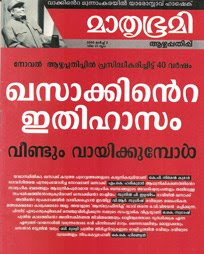
Mathrubhumi

MathrubhumiA few months back, a dear friend subscribed Mathrubhumi magazine in my name. After a gap of more than ten years the magazines sealed carelessly in plastic covers had begun to sail towards me crossing oceans.

It wasn't dejavu this time, even as I opened the first magazine in exhilaration trying to reach across the other side of a reader's memory. I can recall the places I'd been when I read some of the landmarks printed in Malayalam. More than the reference-worthiness, what fascinated me was its ability to provoke curiosity and earnestness to causes bigger than oneself without being elitist.

M.T. Vasudevan Nair used to write editor's note for a while. He wrote about child labor and how Chekhov's Vanka pained his conscience. Another note quoted the Indian chief's profound and poetic letter to the great white chiefs in Washington of his fears for the fragile ecosystem and the dying earth's providence. That was when O.V. Vijayan's eco-fiction Madhuram Gayati had begun serializing in Mathrubhumi.

Earlier, scholar and poet N.V. Krishna Warrier led the editorial team. I could sense their quite confidence and brilliance in the way they put out the magazine and paved way for intelligent and insightful discourses. I couldn't have known Nitya or Octavia Paz or Brodsky the way I did had it not been the space given to independent thinkers in the pages of the magazine.

Another major attraction was the illutrations of A.S and Nampoothiri who complemented writers' imagination and more often than not surpassed readers' mental image of the landscapes and characters.

Somehow the magazine managed to complement my eclectic and random reading delightfully. I still remember reading Kamala Das's childhood memoir and V.K.N's inimitable Payyan tales. Same pages had varied and unique voices of the world - Axel Munthe, V.S Khandekar, Sunil Gangopadhyaya, Bhishma Sahni and Marquez who romanticized his own private cinema paradiso in the rickety movie halls in Bogota.

The reappearance of this magazine in another shore isn't connecting with me. May be I am left behind. Or I am more into connecting the dots between NPR radio and nytimes.com now. Since the primary readers of Mathrubhumi live faraway, their perception of reality and worldview is now circumstantially remote.

Yet I am indebted to my friend who cared way more than I ever did to do this for me. Thank you P.K.

Wednesday, February 04, 2009

The Path of the Prophet: Triumph of defeat


Charioteer from the epic - charioteer, the Prophet spoke to the brokenhearted traveler: “Kurukshethra was never finished.”

Traveler asked: “When does Kurukshethra become complete?”

Charioteer smiled. He said: “We have learnt that when you take absolute away from itself, absolute remains. However when you stack absolute over absolute, it transcends itself.” Charioteer continued: “absolute is nothing but a dimension involving space and time. Human spirit cannot traverse the transcendental . Even their quantum mathematics is scared of accepting the challenge. However the "transcendental absolute", in times of great uncertainty becomes one of us - it takes birth and dies. Look…

Auschwitz, the city of gas chambers where tens of thousands of Jews were charred to death. In the gloom of human sacrifices, Christ’s newly weds, nuns knelt down in the glimmer of a lone candle light and chanted:

“O Virgin Mary, O Mother of god
Pray for us sinners, now and all the time.”

Piercing through the blinding walls, the Prayer in the face of evil became the prayer of all human tribes. The candle light flickered on the walls. The seeker was aghast at the nail marks left behind by Jews as they wrote the last musical notes of mortal pain as they died exhaling the gas. The king with the crown of thorn wailed from his cross: “My brothers! Would I ask my maker to punish you for the guilt of not recognizing me? Why do my priests allege the guilt of vengeance on me? My lord! But the cup of accusation is more unbearable. “

The chants of nuns became mourning: “O Virgin Mary, the most merciful, let this prayer be with the testament written in the agony of your son.”

The flame of love - presence of a martyr. The atom of love cleanses the sins of a world bent on destroying, and lends freedom to the galaxy of stars. The chariot rolled on. Presently it finds itself in the valley of golden apples. Charioteer asked the traveler: “Do you remember these trees?”

“I do. The forbidden fruit of knowledge.”

“With all due respect, you didn’t get it right! Sin and punishment are nothing but a fiction of make-believe fear. By eating these fruits you cannot get knowledge but learn all the tricks to create toys and weapons. In His creation there is only love, no schemes to punish.”

The children of humans who ate the fruits of tricks built up empires. They erected fortresses of technology, architected toy houses to fornicate and giant armories to wage wars. The competed among themselves to grab the lion share. The footprints of the Prophet who walked away unnoticeably from their insatiable lust were upturned.

Traveler asked the man clad in nothing but a loin cloth who waited alongside the highway to freedom: “why are you eating nothing but leaves.?”

“This is my food - fallen leaves. I walk by the benevolent avatar Kali without troubling vegetation or animals.”

The seeker asked: “You walk in loin clothes, sustain life with leaves - aren’t you losing it all?”

“Yes”

“Why?”

“Look yonder…”

Tribes and castes clamored to fight each other! Kurukshethra is replete with apocalyptic arsenals. Gita author confesses at the end of each cycle of Kurukshethra. The final stanzas of the prophecy were silenced to obscurity by the roar that rose from the parade for weapons of mass destruction: Maa Nishada! Do not kill! Isn’t the defeat of a loin clothed fakir preferable?

* * *

"an eye for an eye will make the whole world blind" - Gandhi spoke as he squatted in Naokhali, he knew he was confronting the medieval monster. Anybody who took him for a fool underestimated his awareness of the epic sweep of subcontinental history . He demanded a secular fiber from the Jehadi, called his attention to non violence and co-existence. He knew he was waging a lone campaign against a million revolts in the name of Gods strewn across centuries.

Martin Luther King made a choice. Nelson Mandela couldn't have taken another path to freedom. Gandhi's one man act reminded Indians to choose life over death. Didn't we know that already?

The Path of the Prophet: the revelations


Reading O.V. Vijayan prompted me to pick up on the theme of India as an Idea. I keep going back to random pages of his “The Path of the Prophet (1992)” and marvel at the insights on offer. And I have not been reading much of late.

Vijayan was a unique voice you wouldn’t find clamoring for attention, especially among the mountain of schmaltzy Diasporas, or post colonial master servant dichotomies or countless other broadsides heaped on India. His career as a cartoonist and having lived in Delhi during the tumultuous decades of Indian experiment of democracy and nationhood elicited quite a number of stand out observations from him.

Vijayan saw India essentially as a conflation of many ideas left behind by millennial prophets from the Vedic period, the Buddha, Nabi, Christ, Nanak, Marx and Gandhi. Their ancient and modern manifestations are alive in unexpected corners in violent and sometimes harmonious fashion. As you travel in time through centuries long strife you sense the kind of dejavu that accompanies a fatalistic realization of this land’s survival from invasions. Vijayan set the backdrop of the book a few years and days into the murder of Indira Gandhi and the subsequent butchering of Sikhs in Delhi.

Narayanan - Vijayan’s alter ego in the book narrates the story of his father who imparted the wisdom of Gita, which he acquired from the world war I as a soldier when he lay down under the benevolence of small pox bacteria.

“First world war - In the sand dunes of Mesopotamia and in the legendary banks of Tigris and Euphrates, my father fought. Narayanan listened to the story snuggling in the lap of his father. The soldiers squatted in the trenches they dug in the dirt and sand and meditated on the love they left behind. Meanwhile a procession of another tribe was crossing their path - an exodus in search of Promised Land.

“Do you know who were they, Nanoo?” Asked his father and he answered himself: “they were bacteria on their journey from another battlefield, to get some rest.” Father contracted the pox bacteria. Fellow soldiers insisted that their ill compatriot couldn’t be allowed to stay inside the trench in order not to spread the disease. They wanted him shot and thrown into the cauldron of summer fire. Their commander, Capt. Gurmit Singh stopped them. He took father over to a tin shed and kept a leather pouch-full of water in it. On his way back to the trench, he was shot and killed by enemy fire.

In a soldier’s language, father explained the stories of the battles and retreats of bacteria as if they were yet another enunciation of Gita: Mankind is the disease of this earth - just like them, bacteria the micro mankind - they travel, discover, migrate - make tribal empires, civilizations, literature, art and entertainment. That indeed becomes our disease.”

* * *

Josef, Narayanan’s friend bemoans the fate of his former communist radical friends in prison who are awaiting death sentence: “They will come out. Staring death in its face and building the mystery of an exotic death have nothing in common. I can‘t really imagine what will they become at the very last moment!”

Martyrdom is only for those who accept God as their father. Like the crucifixion of Christ, only a soul can claim real martyrdom. How can enzymes and proteins claim martyrdom? When communists die, it will be reported in pamphlets and notices as mere deaths - meaningless deaths! A few things disintegrate and vanish around you - dreams, truth, periods of history, masteries sewn up in fat leather jackets. In the end, what left would be a glimmer of one’s own solitude and a short distance across. The human, bereft of civility and compassion stands alone, crumbles apart into minerals and chemicals, becomes one’s own prophet and speaks gibberish… Bhagat Singh was reading Lenin’s autobiography into the last few days of his life. What would an individual sentenced to death, pick up from such a book? Bhagat Singh and his comrades were moving towards a grand boundary. What was that lay beyond the fence? Each one of the prophets passed by, asking the same question.


* * *

While Sikh uprising troubled northern India, Narayanan met with Sujan Singh, a world war veteran and a taxi driver in Delhi - with whom he shared some of his thoughts and fears. During one of the rides, Sujan Singh as he takes the Journalist Narayanan to Rasuyi where a roadside death needed to be reported decides to call on Indian democracy:

Sujan Singh said: “this is just a beginning, Saab. Mark my word. Soon the country will fall into the hands of lawless goons. One of them has been shot dead in the middle of the road, in Rasuyi.”

Thugs have grabbed a nation of majestic lineage. People cheer on as triumphant plunderers flaunt their crowns, while the thief finds himself in the palace, feasts on left over from the empire, stands tall on the empire’s stilts and advice its simple subjects.

“The ruling class in India” Sujan Singh continued: “what they need is short respites, for that they will sacrifice Punjab.”

“Remember, we do not have an enemy to fight anymore. There won’t be another Bangladesh, most likely another nuclear test.”

“Or else a genocide!”


Note: The text in Italics is original translation by me. To keep the discussion on track, I 've selected the pieces randomly from the book. Another part to follow...

Friday, December 05, 2008

India's unfinished business with Pakistan

India was supposed to be an idea - a final destination for many a weary traveler seeking an enlightening unknown and for many others a final frontier queer enough to conquer, loot and crush. To think about the world's most populous democracy and emerging economy in medieval light seemed totally out of place in times of globalization, until a week ago.

Terrorists emerged from the gateway of India to inflict untold pain on the psyche of an ancient India decked in new age garb. It could've been Ghazni's mercenaries cutting through Khyber pass on their way to a million savageries no matter how many times they had been rebuffed and magnanimously offered their lives back. They return with greater brutality, wilier deception and a malicious smile at the weakness of their opponent.

Centuries have hard wired the orgasmic passion for violence on the wild things and their offspring who lived westwards of Khyber. Ever since Genghis Khan legitimized the philosophy of kill to live, central Asia was nothing but killing fields for the organized mercenaries. Islam has tagged itself on to it later as merely a context to vanquish the other a.k.a infidels. India was always the final frontier for the motivated. Unfortunately it still is the same.

Even after repeated defeats in wars and proxy wars at the hands of a democratic India, even after the country had been split into two, even after world's rapt attention on the failure of their own state, Pakistanis are in a perpetual denial of reality. The abyss shown by Pakistan's forerunner, Afghanistan was never enough for the plotters in that country to doubt what destiny has in store. For them this is supposed to be a small phase, in fact an insignificant price to pay for the greater and purer Pakistan notwithstanding what they are up against. During nineties they were executing their plans meticulously with an insipid secular Congress government in power, belligerent but wayward right wingers in opposition, China in tow, splintered Soviet union and an indifferent U.S.A run by big mouth liberals from the left.

Kargil war was supposed to be the beginning of the end. It was, but in a direction that wasn’t anticipated. World events, pivoting around America's war on terror, realignment of "rogue" elements with Al-Qaeda and Palestine's political obliteration led the international attention eventually towards Pakistan. Iraq war has been nothing but Bush's miscalculation and a distraction.

The raison de'etre for Pakistani Army is its unfinished business with India. They antagonized and bled India in every available opportunity. They experimented with democracy and international institutions (major supplier of soldiers to U.N peace keeping missions) to thwart Indian diplomatic efforts, aligned military institutions including ISI with Jehadists who had no regional ambitions to challenge India with frugal resources. However the global war on terror, while Jehadis looking to usurp power and Taliban on the run complicated the equations.

Thus it's become an unfinished business of India to dismantle Pakistani terror camps, cut down the Pakistani monolith - Armed forces and destroy their borrowed/stolen nukes.

Sunday, September 28, 2008

Free falling free market and McCain's message

When I looked around to buy a house in the land of opportunities during the last quarter of year 2005, I couldn’t help wondering about the apparent but glossed over disconnect between real estate prices and real buying power of average Americans. House prices spiked dramatically at the rate of 200 percent in less than a year. Mortgage lenders and developers sprang up everywhere. Having exhausted those with a credit history, they turned their attention towards the softer underbelly of the population - barely legal immigrants and job hopping victims of credit card vultures. To grant them entry into the brave new American dream, their benefactors provided an opening in the name of deferred principle and interest rates a.k.a sub-prime mortgage. In time reality set in - bills began to show up with their true numbers. Occupiers of the houses fled abandoning their unsolicited dreams.

The word spread rapidly. Foreclosure signs began to appear in neighborhoods. Soon everyone understood what Katrina had forewarned. Once the canopy of denial is flung open, you know the dweller of the pretty home across the street was a poor man made homeless by greed.

But what I didn’t realize like everyone else then was the depth to which housing speculators had dug their hands to fund the project to build a home for every decent and hard working American. Insurance companies, mutual funds, investment bankers had all diverted funds into the project to make some fast buck. Its unreal to think that companies like Lehman Brothers and Investment banks like Washington Mutual which survived the great depression of 1930s would go belly up with a day’s notice. Insurance giant AIG is propped up by the Federal government for now. So are Merrill Lynch and Goldman Sachs. Retirement funds and other savings are at risk to send shivers through many an aging bones.

Most significant fallout of all this is its worldwide impact. China made major investment in U.S market. So are the Japanese, Germans and Oil barons in the middle east. Even ICICI bank in India had a major investment in Lehman Brothers. Stock markets around the world have been shaken by this quake which may not have reached its highest point yet.

At the core of this problem is the sustained implementation of Republicans’ conservative ideologies on government’s role in capital market and legitimization of corporate greed. Reagonomics of deregulation and huge tax cuts and credits to big corporations were continued for the past two decades with republican dominated senate and congress even though Clinton, a conservative liberal was president during its time of bliss. Another aspect of republican politics is its clever and tactical use of wedge issues such as abortion and gay rights with biblical references to undercut criticisms from the left on its economic policies, especially during elections. Clearly, the Republicans favor rich folks who need geopolitical and logistical opportunities to make their billions since we now know a lot more about Enron adventures in third world countries, tax credits for self-serving Oil corporations and how Iraq became a goldmine for Halliburton. Deregulation is the toast of the time and yet the number of career politicians accused of corruption and behind bars are increasing.

There is a significant section of Americans who are blissfully unaware of world’s perception of themselves. They fear change and embrace status-quo. For them there is no creature more disgusting and revolting than a liberal democrat who is out to increase tax and unleash gays into their private Christian lives. They do not care a fig about the world and they truly believe that the war in Iraq is convenient and after all things considered Pakistan is still an ally. Drop names like Nancy Pelosi and Harry Reid - they’ll run to polling booth to vote for a serial killer under republican column.

It is important to note that the sternest opposition to W. Bush‘s $700 billion bail-out plan has come from the Republicans and not Democrats. They are worried about facing impending senatorial and congressional elections and the real possibility of owning up a greater depression if things took a turn for the worse. No wonder Republican presidential hopeful McCain is doing everything he can to usurp the message of change from Obama. He lived most of his life during the cold war era and appears to be cruising in a time machine inexorably into the past. He admitted several times that he has no clue on economy and he would rather spend his time on foreign policy. Engaging in geopolitical conflict a.k.a war economics is after all a Republican contribution to humanity. Given that depression is unofficially declared, McCain’s military Keynesianism is just what the doctor order to secure this damn world.

Friday, March 28, 2008

Celebrating Folk Art


It seemed like a long time ago when time was still timeless, I had an affliction of color and sound. My mind for the first time, was registering the overwhelming play of bright colors and engrossing sounds of yearly festival at the temple in our neighborhood. Even the color of candies which the seasonal peddlers stacked upon their makeshift stalls added an ethereal sheen on the phantasmal vision unfolded in front of my eyes.

The soothsayer song in praise of snake deities, loud and stout looking actors on stage enacting extra-terrestrial battles from Ramayana and Mahabharata , the balloon man with his mobile paraphernalia - those were the early connectors to the heritage of the land and expressions of a world order that defied the onslaught of time as long as they did.

It was much later when I began to notice earthier and rather primordial forms of folk art such as Ayyappan Paattu, songs in praise of Dravidian gods (Muthappan, Vishnumaya) along the sidelines of flashier performing arts. In them, deep down I could sense a sort of cathartic realization of individual and collective dreams and fears which otherwise would have never ever made it out of the subconscious domain or exploded into something sinister and dark.
The national festival of Kerala - Onam was borne out of a folk legend and an occasion to celebrate all sorts of folk arts - ritualistic and secular (such as Tiger dance, Kummatti Kali etc). More than its significance as an age-old tradition, Onam brought up a grand setting for people to celebrate life and revel in others' joy.

Some of the shapes and forms I have seen in the traditional settings of Kerala were intense enough to let go on my growing apprehensions of the general lack of development and modernity in the state's social life. The richness of the folk art easily filled the wide gaps of general deprivation and the prevalence of snobbery among the audience and practitioners of classical arts. Often I have marveled at the striking similarity of Theyyam and Kathakali in their costumes and how Theyyam invariably breaks into bouts of cries as opposed to the finesse of aural and literary tradition of Kathakali. The social dynamic at work here was too stark to pass up.

The dialectics in folk art has been cleverly adopted and manipulated by political strategists, especially the communists who engrained their ideology in seemingly innocuous and subtle variations of folk music practiced and enjoyed by workers in the fields. Later on popular poets used the structure and sounds of folk music to lend an exciting latitude of folk imagery and unexpected dimension to their art. Listening to such poems in their native languages like Malayalam, Marathi, Bengali etc have become a unique experience. Translating them would not have made any sense at all.

However the most impressive of all folk arts has always been music. The rhythm and sounds of folk music have a rare ability to cut through the carefully manicured fences of culture and language. The aspirations of common folks rising in unison resonate naturally with their ilk around the world and touch hearts in a unique way - whether it is a group of Moravian gypsies assembled in a tavern, a Texan singing Americana, a Baul singer walking down the beaten fields or a bunch of farmers somehwere in a nondescript islet in Kuttanad, rhapsodizing the season of harvest and pleasures of simple unhurried life of yore.

Living in a time when Hypermodernity and globalization are often confused and utterly inadequate terms to describe human and to a great extend mother earth’s conditions, folk art may be able to offer much needed healing for our electrocuted humanity. Although we will never return to the refuge of rural and agrarian setting, there can be only simple solutions for our complicated problems.

I remember reading Milan Kundera as he spent an entire chapter to discuss folk music and modern society. He spoke about men being weary under the weight of their own ego and mistrust of their identity:

...and I felt happy within these songs, in which sorrow is not reckless, laughter is not crooked, love is not ridiculous and hate is not apprehensive, where people love with their bodies and souls, where they draw knives or sabres in hatred, dance in joy, throw themselves into the Danube in despair, where, for that matter, love is still love and pain is still pain, where the original emotion is not yet devoid of itself and where values are still unravaged; and it seemed to me that within these songs I was at home, that I had my roots in there. That their world was my primal point of reference... (from Joke)

* * *

Notes:
Some of the most evocative use of audio and visual expositions of folk arts have been employed in popular and offbeat Indian movies - Aravindan's Kummatty comes to my mind. The entire film was based on a folk tale with a rousing treat of folk music. Nokkukuthi (scarecrow) was another experimental effort based on M. Govindan's poem depicting a ballad. Other folk arts like the popular Theyyam, Kalam paattu have always had their place in popular movies. Mani Kaul did a documentary on Rajasthani puppetry and a film Duvidha, based on a folk tale.

Info on Kummatti here

R. Ramachandran

R. Ramachandran (1923 - 2005) lived the life of a poet though he wrote rarely. If you'd asked him about his reasons to write, he would...